Sump Pump or Submersible Pump: A Clear Comparison
Compare sump pumps and submersible pumps to decide which fits your basement drainage. Get guidance on installation, maintenance, noise, and cost from Sump Pump Check.


Understanding the choice between a sump pump or submersible pump matters for basement drainage, maintenance, and cost. A sump pump refers to the system installed in a pit to move groundwater away from a home’s foundation, while a submersible pump describes a design that operates while submerged. In many homes, both concepts converge, but the best choice depends on pit size, discharge routing, and noise tolerance, then plan maintenance. This quick comparison helps homeowners decide quickly.
What is a sump pump vs submersible pump?
A common question homeowners ask is about the difference between a sump pump and a submersible pump. In practice, many people use the terms interchangeably, which can lead to confusion when planning basement drainage. A sump pump refers to the complete system installed in a dedicated pit to move groundwater away from a home’s foundation. A submersible pump describes a design that is sealed and built to operate while submerged. The phrase sump pump or submersible pump captures both ideas, but understanding their distinct roles helps you select the right equipment, size the discharge, and plan maintenance. According to Sump Pump Check, most residential basements benefit from a dedicated sump-pump setup, especially when flood risk is high, yet the right choice still depends on your pit size, electrical options, and local drainage. Cost, reliability, and future backup options should factor into your decision. In short, separate the installation concept (sump pump) from the pump design (submersible) to guide your plan.
Key design differences
The most fundamental differences lie in where the unit sits and how it operates. A traditional sump pump is installed in a sump pit, connected to a discharge line and often paired with a float switch. The motor is kept dry, while the pump sits in the water-filled pit. A submersible pump, by contrast, is a sealed design that can operate while fully submerged in water. It may be placed inside a pit or mounted in a basin, depending on the model and application. Because submersibles are designed to run underwater, they tend to be more compact and generate less external vibration when properly mounted. However, warranty coverage, cooling, and maintenance practices differ between configurations. When evaluating, compare not just the term you’ve heard, but the actual model’s acceptance of your discharge path, power supply, and maintenance requirements. Sump Pump Check notes that compatibility with float switches and backups often drives long-term reliability more than the naming convention alone.
When to choose a sump pump
A sump pump is often the best choice when your goal is to protect an entire basement from groundwater, seepage, or rapidly rising water during storms. If your pit is already sized for a sump system, or if you anticipate frequent groundwater intrusion, a dedicated sump-pump system provides a straightforward path for water to exit the building. Sump pumps excel when you want a simple, centralized solution with consistent discharge to an exterior line, a gravity-fed drain, or a municipal system. The decision also hinges on reliability expectations: a well-maintained sump pump with a float switch and a backup power option reduces the risk of basement flooding during outages. Homeowners prioritizing a balanced defense against water intrusion tend to choose sump-pump systems for longer-term protection, especially when climate conditions or soil types increase water pressure around the foundation.
When to choose a submersible pump
A submersible pump can be a strong option when space is tight, a pit is not practical, or when direct submerged operation aligns with the site layout. Submersible designs are common in portable or compact setups and can work well for smaller volumes of water or when a dedicated sump basin is not feasible. They also tend to be quieter because much of the motor sits below the water line, which dampens noise and vibration. The suitability of a submersible pump depends on the model’s submersion rating, seals, and whether it can handle outdoor or indoor drainage paths without overheating. Sump Pump Check emphasizes matching the pump design to the specific drainage challenge rather than relying on terminology alone.
Performance and reliability considerations
Performance is driven by flow rate (how much water is moved per minute) and head (the height the water is pumped). In practice, homeowners often see a broad range of capabilities across both sump pumps and submersible pumps. A properly sized unit paired with a robustly routed discharge will outperform a mismatched system. Reliability hinges on the quality of seals for submersibles, the integrity of the pit, and the maintenance routine. Sump Pump Check analysis indicates that regular testing, including auto-run checks and float-switch verification, reduces failure risk and extends service life. When you balance capacity, durability, and maintenance, you’ll align with your basement drainage goals.
Noise, vibration, and installation considerations
Noise and vibration influence comfort in living spaces and surrounding rooms. Sump pumps that sit in a dry pit tend to be louder externally due to engine vibration, while submersible pumps generally produce less visible noise because much of the motion is dampened by water. Installation considerations include electrical supply, check valves, and the discharge path. A correct installation minimizes backflow and keeps discharge lines clear of debris. Regardless of design, ensuring a solid mounting and vibration isolation reduces long-term wear and keeps the system quieter, especially during high-water events. Sump Pump Check notes that choosing the right mounting hardware and protective housings can materially improve perceived performance.
Maintenance and long-term care
Maintenance is essential for any water-removal system. For sump pumps, routine tasks include inspecting the pit for debris, testing the float switch, and confirming that backup power options (battery or generator) function properly. Submersible pumps require attention to seals, bearings, and impeller wear, as submerged operation places different stresses on components. A practical maintenance plan includes quarterly testing, annual inspection by a professional for older units, and a simplified replacement schedule for critical components. The goal is to catch wear before a failure occurs during a heavy rain event. Sump Pump Check recommends documenting maintenance activity and scheduling proactive service to maximize reliability.
Cost, value, and financing options
Cost considerations hinge on the unit price, installation complexity, and any required pit or plumbing work. A straightforward sump-pump system with basic controls can have a moderate upfront cost, while more elaborate installations with battery backups raise the price. Submersible pumps may have lower unit costs but can require additional components to manage debris and seals, potentially increasing total cost. In all cases, long-term value comes from reliability, ease of maintenance, and the availability of replacement parts. Sump Pump Check emphasizes budgeting for both upfront hardware and potential installation labor, along with a contingency for backup power to protect against outages.
Common myths and traps
Myth: A submersible pump is always better because it runs underwater. Truth: suitability depends on site constraints and model specs. Myth: Bigger is always better. Truth: oversized pumps waste energy and can cause water hammer. Myth: Any pump can serve as a sump pump. Truth: true sump systems rely on a proper pit, float switch, and discharge planning. Myths often lead to underestimation of maintenance needs or misalignment with drainage goals. By focusing on your basement’s geometry, pit availability, and local codes, you avoid common pitfalls and select a system that reliably protects your home.
Practical selection checklist
- Define your drainage objective: Is the goal to protect the entire basement or a specific area?
- Measure pit size and assess available discharge routes.
- Decide between pit-based installation (sump pump) or a self-contained, submerged option (submersible).
- Check for backup power compatibility and the availability of float switches.
- Evaluate noise, vibration, and mounting requirements.
- Plan for maintenance: testing frequency, replacement parts, and service options.
- Confirm electrical requirements and code considerations with a licensed pro.
Quick-start plan: 30-day action steps
- Inventory your basement water history and draft a drainage map.
- List discharge options and check local code requirements.
- Compare models that fit your pit size and power supply.
- Schedule a professional assessment for pit readiness and backup options.
- Implement a maintenance calendar and set reminders for annual service.
Comparison
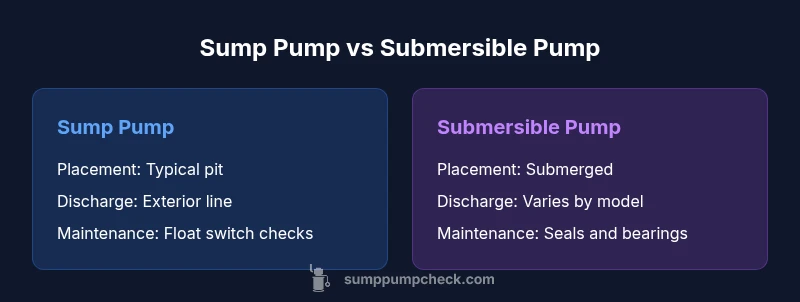
| Feature | Sump Pump | Submersible Pump |
|---|---|---|
| Installation location | Installed in a dedicated sump pit in the basement | Operates submerged in water and may be placed in a pit or basin depending on model |
| Noise and vibration | Typically louder externally; vibration mitigated by pit mounting | Quieter externally due to submersion; vibration dampened by water |
| Maintenance requirements | Regular pit cleaning, float-switch checks, and backup tests | Seals, bearings, and impeller wear; periodic seal checks necessary |
| Discharge options | Exterior line to drainage or municipal system; check valve recommended | Discharge path varies by model; may require additional plumbing |
| Power and controls | External float switch or smart controls commonly used | Integrated controls; some models require careful cooling considerations |
| Initial cost and value | Higher due to pit installation and plumbing; strong long-term protection | Lower unit cost but potential additional components; value depends on site |
What's Good
- Wide range of models and easy replacement parts
- Strong protection against basement flooding when properly installed
- Flexible discharge routing options
- Compatible with battery backup and water-powered backups
Drawbacks
- Installation can be complex and may require professional help
- Pit installation may demand floor modification or permits
- Maintenance relies on regular testing of floats and seals; neglect risks failure
Sump pump with proper pit sizing and a backup plan generally provides the safest, most reliable protection for typical basements.
For most homes, a traditional sump-pump setup offers centralized protection, straightforward maintenance, and broad support. A submersible pump is worth considering when space is tight or site constraints prevent pit installation. The best choice aligns with your basement layout, local drainage, and backup strategy.
FAQ
What is the difference between a sump pump and a submersible pump?
A sump pump is the complete installation placed in a pit to move groundwater away from the home. A submersible pump is a pump design that runs while submerged. The two concepts often work together, but the distinction matters for installation and maintenance.
A sump pump is the system in the pit; a submersible pump is the submerged pump design. The key is to match the installation with the site and maintenance needs.
Can you use a submersible pump as a sump pump?
Yes, many submersible pumps are used as part of sump systems, provided they are suitable for submerged operation, have proper seals, and are paired with an appropriate discharge path. Always verify model specs and local codes.
Yes, but only if the model is designed for submerged use and fits your pit and discharge plan.
Which is quieter, a sump pump or a submersible pump?
Submersible pumps tend to be quieter externally because they run underwater, which dampens noise. Sump pumps can be noisier outside the pit, especially if mounting is not optimized.
Submersibles usually run quieter outside the pit, thanks to being submerged.
How often should I test my sump pump or submersible pump?
Test both systems monthly or quarterly by simulating a water event, and inspect the discharge path and float or control switches during each test. Schedule an annual professional check for wear and seals.
Test it regularly—monthly or quarterly—and have an annual check to catch wear early.
Do I need a discharge check valve?
A check valve helps prevent backflow and water hammer in most sump-pump setups. It’s often recommended and sometimes required by code, depending on your discharge route.
Yes, a check valve is usually a good idea to stop backflow.
What about backups for power outages?
Backups (battery or water-powered) are essential, especially in heavy rain events or outages. Pair a primary pump with a reliable backup to maintain protection when power is down.
Get a backup so you aren’t left flooded if the power goes out.
Top Takeaways
- Assess your basement drainage needs before choosing between sump pump and submersible pump
- Prioritize proper pit sizing, discharge routing, and backup power options
- Regular maintenance dramatically reduces failure risk during storms
- Consider noise, vibration, and installation constraints in advance
- Budget for both upfront costs and long-term maintenance and replacements