What Is the Best Sump Pump Horsepower for Your Home?
Discover how to choose the right sump pump horsepower for your basement. This data-driven guide explains sizing, scenarios, and long-term costs for homeowners, based on Sump Pump Check Analysis, 2026.


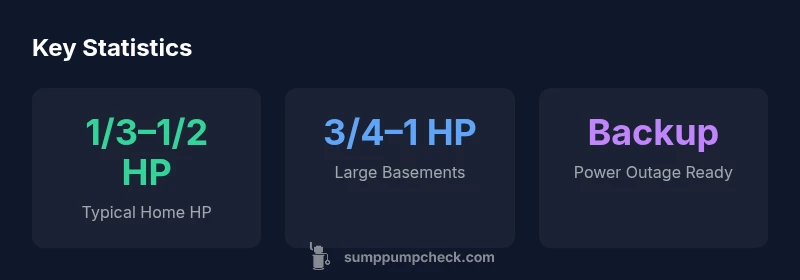
There isn't a universal 'best' horsepower for sump pumps—the right choice depends on basement size, pit volume, and rainfall. For most homes, a 1/3 to 1/2 horsepower pump provides adequate flow and efficiency. If you have a large basement or frequent heavy rains, consider a 3/4 to 1 horsepower unit to reliably move water during storms.
What horsepower means for sump pumps
Sump pumps are sized by horsepower (HP), but horsepower alone does not tell the full story of performance. HP is a rough proxy for a pump’s ability to move water against a vertical lift (the height water must be pushed up) and through a discharge line with friction losses. In practice, a smaller HP can move water efficiently in a small basement with short discharge runs, while larger basements or longer, higher runs require more HP to maintain a reasonable flow during heavy rain. When evaluating horsepower, homeowners should also look at the pump’s flow curve, head pressure, and the pump’s impeller design. A higher HP pump does not always deliver proportionally more water at all heads; it’s most efficient within the right operating range. For most homes, the goal is to find the smallest HP that meets your peak demand, rather than simply installing the strongest model.
How to estimate your needs
First, measure or estimate the area that the sump pit must drain. Larger basements produce more water, increasing the required flow. Next, estimate the vertical lift: from the basin to the discharge point, including any altitude difference and vertical piping. Longer horizontal runs and steeper elevations reduce flow, so you may need higher HP to compensate. Consider the typical rainfall intensity in your region and whether you have a single or multiple drainage points. If you frequently experience power outages, plan for a backup sump pump as well, which may have its own horsepower rating. Finally, review the manufacturer’s performance curves for each model; these curves show how many gallons per minute a pump can move at a given head. Use these curves to pick the smallest HP that meets the expected peak flow without oversizing.
What is the best horsepower for a sump pump
Understand that there is no one-size-fits-all horsepower. The best horsepower depends on your basement size, pit capacity, discharge distance, and rainfall patterns. For most homes, a 1/3 to 1/2 horsepower unit provides reliable protection with modest energy use. If your basement is large or you have long discharge runs, a 3/4 to 1 horsepower model may be warranted. Always choose the smallest model that reliably clears a flood, and plan for a properly sized check valve and correct electrical circuit.
Reading pump curves and specs
Manufacturers publish head-versus-flow curves for each model. Your goal is to identify the point where the pump can deliver the required gallons per minute (GPM) at the anticipated head height (the total vertical lift). Horsepower correlates with potential flow, but performance varies with head height. Don’t rely on HP alone; compare curves across models, paying attention to shut-off head and operating range. Check valve compatibility and piping diameter affect actual performance more than raw HP in some setups.
Sizing mistakes to avoid
Common mistakes include assuming bigger HP always fixes drainage issues, ignoring discharge elevation, and undersizing for the peak storm load. Oversizing wastes energy and increases upfront costs, while undersizing leads to frequent pump cycling and wear. Always factor in pit size, discharge distance, elevation changes, and backup needs. A correctly sized system performs reliably with minimal energy use.
Installation considerations and electrical basics
Sump pumps require a dedicated circuit, typically 15-amp or 20-amp, with GFCI protection near the pump location. Wiring should use a suitable gauge for the distance to the panel, and ensure the outlet is protected from moisture. If you’re adding a backup pump, plan a separate circuit with a transfer switch or an automatic start feature. Properly sizing the circuit reduces nuisance trips and ensures reliable operation during storms.
Efficiency and ongoing costs
Larger HP models deliver more flow but consume more energy, especially during extended pumping cycles. Consider how often you expect to run the pump during storms and the local cost of electricity. Choosing the smallest HP that meets your needs can lower energy bills and extend pump life by reducing run-time stress. Regular maintenance keeps the system operating at its intended capacity, preventing hidden inefficiencies.
Quick decision framework: turning data into a choice
- Estimate peak water volume based on basement size and typical rainfall. 2) Determine the total head height for your discharge path. 3) Compare manufacturers’ curves to find the smallest HP that meets peak flow. 4) Plan for backup (if power outages are common). 5) Verify electrical and plumbing compatibility before purchase.
Case studies: real-world sizing scenarios
A small 800–1,000 sq ft basement in a temperate climate with a short discharge run typically uses a 1/3–1/2 HP pump. A mid-sized, 1,500–2,000 sq ft basement with a longer run and occasional heavy rain may benefit from a 1/2 HP, sometimes edging into 3/4 HP. A large basement (>2,000 sq ft) in a climate with frequent heavy storms often needs 3/4–1 HP, especially if you expect long pumping cycles during storms.
Maintenance and future-proofing your sump pump horsepower
Regular checks of seals, impellers, and float switches ensure the unit can meet peak demand when needed. If you anticipate property changes (expanding living space or catchment area), revisit horsepower sizing to avoid future undersized performance. Consider pairing a primary HP pump with a backup unit that has a matching performance range for reliability during outages.
HP guidance by scenario
| Scenario | Typical HP | Recommended Use |
|---|---|---|
| Small basement, light rainfall | 1/3 HP | Residential, up to ~1,000 sq ft |
| Medium basement, moderate rainfall | 1/2 HP | Residential, ~1,000–2,000 sq ft |
| Large basement, heavy rainfall | 3/4–1 HP | Residential, >2,000 sq ft |
FAQ
What horsepower do I need for a small basement?
For many small basements, a 1/3 to 1/2 horsepower pump provides reliable performance with lower energy use. Verify with the manufacturer’s curve for your head height and discharge distance.
For a small basement, 1/3 to 1/2 HP is usually enough.
Is a higher horsepower pump always better?
No. A larger HP pump can waste energy and cost more upfront. Size it to your peak flow needs and head height, then consider backup options.
No—bigger isn’t always better for your basement.
Can I use a 1/4 HP pump?
Some backup systems use 1/4 to 1/3 HP, but performance depends on head and discharge. Check curves and ensure adequate flow during storms.
A 1/4 HP can work in some setups, but verify with the head and flow curves.
How does head height affect horsepower choice?
Higher head height (lift) requires more HP to maintain flow. Measure vertical lift to the discharge point and compare pump curves.
If the water has to travel higher, you’ll want more HP.
What about battery backup performance?
Backup pumps often use similar or slightly lower HP than the primary system; pay attention to battery capacity and flow ratings.
Backups matter—make sure the backup pump can still move water during outages.
Should I oversize for future storms?
Oversizing can waste energy and money. Size for current needs with room for occasional growth, then reassess after changes.
Don’t oversize unless you have a clear growth plan.
“Sizing a sump pump isn’t about the biggest motor; it’s about matching flow to your space and climate. Properly sized systems save energy, prevent nuisance floods, and extend pump life.”
Top Takeaways
- Always size to peak demand, not maximum capability
- Small homes typically use 1/3–1/2 HP; large basements may need 3/4–1 HP
- Read manufacturer curves, not HP alone, to estimate real performance
- Plan for a backup pump and proper electrical wiring
- Choose the smallest HP that reliably meets your water removal needs