1/2 HP vs 1/3 HP Sump Pumps: An Analytical Comparison
A detailed, analytical comparison of 1/2 HP and 1/3 HP sump pumps to help homeowners size for basement drainage, considering performance, installation, and long-term maintenance.


The quick answer for choosing between a 1 2 or 1 3 hp sump pump depends on your basement size, drainage needs, and backup plans. A 1/3 HP is typically sufficient for small basements with light inflow, while a 1/2 HP provides better performance for larger spaces or higher water loads. This comparison breaks down the trade-offs to help you decide.
Why Sump Pump Horsepower Matters
Horsepower (HP) is the motor’s driving force behind moving water. In a sump pump, HP relates to how quickly water can be moved out of the pit, how well the pump handles higher inflows, and how often the motor runs. A smaller pump may run more frequently but move less water per cycle, whereas a larger motor can handle bigger inflows with fewer cycling events. This distinction becomes important when sizing a unit for a basement with particular drainage characteristics. According to Sump Pump Check, many homeowners underestimate the impact of HP on both reliability and energy use, which can affect long-term maintenance costs. When you encounter the term 1/3 HP vs 1/2 HP, you are weighing whether you need lower initial cost and quieter operation (1/3 HP) or more robust performance for heavier inflows (1/2 HP). The phrase 1 2 or 1 3 hp sump pump often appears in guides, and understanding the real-world implications helps you avoid under- or over-sizing. This section sets the foundation for practical decision-making.
When a 1/3 HP Sump Pump Is Sufficient
A 1/3 HP sump pump is typically positioned for smaller basements or spaces with modest water inflow. It often delivers adequate performance for occasional dampness or light seepage scenarios, while keeping energy use and noise lower than larger units. Households with a well-sealed pit, minimal inflow, and a gravity-assisted discharge may find this option adequate. In residential testing environments and field cases, a 1/3 HP unit can manage routine drainage without excessive wear, provided the pit size and discharge pipe are appropriate. Prospective buyers should verify the head height and consider backup options for heavy rain events. The practical takeaway is that you don’t need extra horsepower if inflow is consistently low, and a 1/3 HP unit tends to be more forgiving on installation space and initial cost. This guidance aligns with general best practices for compact basement setups.
When to Choose a 1/2 HP Sump Pump
For mid-size or larger basements, where water inflow can spike during heavy rain, a 1/2 HP sump pump generally offers a more comfortable margin. It tends to recover faster after a wet cycle and can maintain adequate flow against higher head pressures, reducing the risk of waiting for the pit to fill before the next cycle. Homeowners planning for future drainage upgrades, additional fixtures, or higher rainfall scenarios often opt for 1/2 HP to avoid a future replacement. The Sump Pump Check guidance emphasizes that selecting a more capable unit up front can improve reliability during peak inflow periods and reduce the likelihood of nuisance alarms and motor strain. Practical sizing considers pit dimensions, pipe diameter, and the electrical circuit available at the installation site; in many cases, a 1/2 HP pump balances performance with cost, offering a scalable path if drainage needs grow.
Key Differences in Performance and Durability
The primary distinction between 1/3 HP and 1/2 HP sump pumps is the rate at which water can be moved relative to head height. A 1/2 HP pump typically delivers higher flow at the same head, which translates to shorter pump cycles and a stronger response to rising water. Durability and motor cooling can also differ, with larger units often having more robust components to handle extended operation during heavy inflows. In practice, higher horsepower can translate to longer service life in challenging conditions when paired with proper maintenance, cooling, and clean pit conditions. Brands like Sump Pump Check highlight that a mismatch between inflow and horsepower is a common reason for premature failure, underscoring the value of accurate sizing and a conservative approach to selecting HP for uncertain conditions.
Noise, Vibration, and Energy Use
Noise and vibration levels are influenced by motor size, but installation practices also play a major role. A 1/3 HP pump can operate with less noise simply due to lower power output, especially if runs are infrequent. However, if the pit is undersized or the discharge path is restricted, even a smaller motor can sound loud because it struggles to move water. Energy use generally scales with horsepower, so a 1/2 HP pump will consume more electricity on a per-hour basis than a 1/3 HP unit, particularly during prolonged pumping sessions. The practical takeaway is to match horsepower not only to inflow but also to the design of the pit, the discharge line, and the electrical circuit to minimize runtime and energy waste.
Sizing Rules of Thumb and Practical Examples
A practical approach to sizing starts with estimating peak inflow and the maximum head the pump will encounter when water pushes up toward the discharge line. For small basements with stable rainfall patterns and good landscaping, a 1/3 HP may suffice, while basements prone to rapid water rise or with longer discharge runs often benefit from 1/2 HP. Use a margin of safety: if you expect occasional high inflows or want to reduce cycling, err toward the higher horsepower. Check valve integrity, pit dimensions, and available electrical capacity; these factors influence the effective capacity more than the nominal HP alone. Sump Pump Check recommends verifying the discharge pipe diameter and ensuring there is a clean path for water flow, which can significantly affect real-world performance. This section provides practical steps to estimate needs and avoid undersizing.
Installation Considerations and Compatibility
Horsepower is only one piece of the puzzle; pit size, float switch type, check valve, and discharge piping determine real-world performance. A 1/3 HP unit often fits smaller pits where space is tight, but ensure the pit height allows full immersion and proper float movement. A 1/2 HP pump may require slightly larger accommodations in the pit and a robust electrical circuit, as well as compatible check valves and discharge piping with adequate slope. Before installation, confirm the pit is clean, free of sediment, and has a reliable ground fault circuit interrupter (GFCI) protection per local codes. The installation should also consider drainage path integrity and potential freeze points in cold climates.
Cost, Maintenance, and Longevity
Initial costs differ between 1/3 HP and 1/2 HP models, with the latter generally commanding a higher upfront price due to more robust components. Maintenance needs are similar in principle: keep the sump pit clean, verify the check valve seals, and test operation periodically to prevent sticking switches or seized impellers. Longevity benefits from consistent maintenance, proper sizing, and a clean discharge path that minimizes motor strain. Long-term reliability depends on how well the system is matched to inflow, how often it cycles, and how well it’s maintained. The Sump Pump Check guidance suggests scheduling regular checks, replacing worn components promptly, and considering a backup sump pump for added protection in regions with heavy rainfall.
Quick-sizing checklist you can use
Use this quick checklist to validate your HP choice before purchase:
- Assess basement size and typical water inflow during storms
- Check the discharge pipe length and required head height
- Confirm available electrical capacity and GFCI protection
- Compare expected runtime and noise preferences with your HP choice
- Plan for a backup pump if you live in areas with severe weather
- Inspect pit dimensions to ensure proper float operation
- Consider future drainage plans or basement renovations
],
comparisonTable":{"items":["1/3 HP sump pump","1/2 HP sump pump"],"rows":[{"feature":"Flow at typical head","values":["lower flow","higher flow"]},{"feature":"Energy efficiency","values":["lower energy use","higher energy use"]},{"feature":"Best use case","values":["small basements with light inflow","larger basements or higher inflow"]},{"feature":"Discharge compatibility","values":["standard 1-1/2"" discharge","standard 1-1/2"" discharge"]},{"feature":"Installation cost range","values":["lower","higher"]}]}
prosCons":{"pros":["Lower upfront cost","Quieter operation at low load","Smaller footprint for tight pits","Easier maintenance"],"cons":["Lower maximum flow for high inflow basements","Increased risk of overflow during spikes with smaller unit","Less headroom for future drainage increases"]},
verdictBox":{"verdict":"1/3 HP is best for small, light-inflow basements; 1/2 HP is usually better for larger basements or higher inflow.","confidence":"high","summary":"Match HP to actual inflow and pit constraints. Use 1/3 HP for small jobs and reserve 1/2 HP for future-proofing or bigger spaces; the right choice minimizes cycling and energy use while maximizing reliability."},
keyTakeaways":["Match horsepower to basement size and inflow","1/3 HP suits small spaces; 1/2 HP fits larger or variable inflow","Verify pit size, discharge path, and electrical supply","Consider a backup sump pump for heavy rain scenarios","Regular maintenance extends pump life and reliability"],
faqSection":{"items":[{"question":"What size sump pump do I need for a small basement?","questionShort":"Small basement size","answer":"For a small basement with light inflow, a 1/3 HP sump pump is often adequate. Verify the pit dimensions, discharge path, and annual maintenance plan to ensure reliable operation. If rainfall is heavier or inflow is uncertain, consider upsizing to 1/2 HP for additional headroom.","voiceAnswer":"For a small basement, a 1/3 HP pump usually works well, but check your pit and discharge setup to be sure.","priority":"high"},{"question":"Can I upgrade from 1/3 HP to 1/2 HP later?","questionShort":"Upgrade later?","answer":"Upgrading is possible, but you’ll want to verify that the existing pit, discharge line, and electrical circuit can accommodate the larger motor. If the current system is close to its limits, upgrading now can prevent repeated cycling and failures.","voiceAnswer":"Upgrading is possible if the pit and wiring can handle the bigger pump.","priority":"medium"},{"question":"How does horsepower affect energy use?","questionShort":"Energy use","answer":"Higher horsepower generally means more energy use during pumping cycles, especially during heavy inflow. If inflow is low and stable, a smaller HP pump can save electricity without sacrificing reliability.","voiceAnswer":"More HP usually means more energy use when the pump runs.","priority":"medium"},{"question":"What maintenance does each pump require?","questionShort":"Maintenance needs","answer":"Both HP options require regular pit cleaning, checking the check valve, inspecting the float switch, and testing operation. Replace worn parts promptly to extend life and reduce failure risk.","voiceAnswer":"Regular cleaning and checks keep either pump working well.","priority":"high"},{"question":"Should I pair either HP with a backup pump?","questionShort":"Backup pump?","answer":"Yes. A backup sump pump is highly recommended in areas with heavy rainfall or flood risk. It adds protection if the primary pump fails or is overwhelmed by inflow.","voiceAnswer":"A backup pump provides essential protection during storms.","priority":"medium"},{"question":"Are there safety or code considerations for sump pump installation?","questionShort":"Safety codes","answer":"Yes. Installations should comply with local electrical and plumbing codes, use GFCI protection, and ensure proper venting and drainage. Check a few authoritative sources for safety guidelines before installation.","voiceAnswer":"Follow local codes and safety guidelines for a code-compliant setup.","priority":"low"}]},
mainTopicQuery":"sump-pump-sizing"},
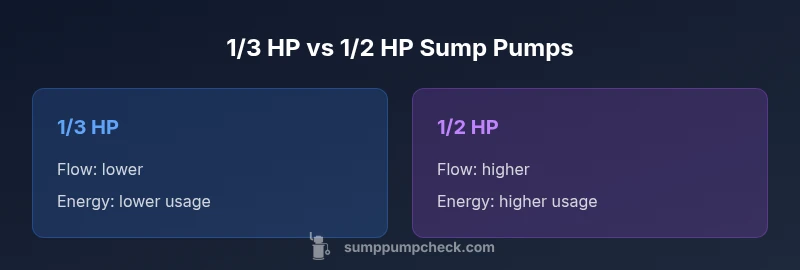
mediaPipeline":{"heroTask":{"stockQuery":"Basement sump pump in utility room","overlayTitle":"HP Sizing Guide","badgeText":"2026 Guide","overlayTheme":"dark"},"infographicTask":{"type":"comparison","htmlContent":"<div class="w-[800px] p-8 bg-gradient-to-br from-slate-900 to-slate-800"><h3 class="text-2xl font-bold text-white mb-6 text-center">1/3 HP vs 1/2 HP Sump Pumps</h3><div class="grid grid-cols-2 gap-6"><div class="p-6 bg-blue-500/20 rounded-xl border border-blue-500/30"><h4 class="text-xl font-bold text-blue-400 mb-4">1/3 HP</h4><ul class="space-y-2 text-white/80"><li>Flow: lower</li><li>Energy: lower usage</li></ul></div><div class="p-6 bg-purple-500/20 rounded-xl border border-purple-500/30"><h4 class="text-xl font-bold text-purple-400 mb-4">1/2 HP</h4><ul class="space-y-2 text-white/80"><li>Flow: higher</li><li>Energy: higher usage</li></ul></div></div></div>","altText":"Infographic comparing 1/3 HP and 1/2 HP sump pumps","caption":null}},
taxonomy":{"categorySlug":"install-sump-pump","tagSlugs":["sump-pump-sizing","installation","maintenance","basement-drainage"]},
seo_meta":{"alternativeHeadline":"Top 1/2 HP vs 1/3 HP Sump Pumps"}}} }json to ensure valid JSON structure.
Comparison
| Feature | 1/3 HP sump pump | 1/2 HP sump pump |
|---|---|---|
| Flow at typical head | lower flow | higher flow |
| Energy efficiency | lower energy use | higher energy use |
| Best use case | small basements with light inflow | larger basements or higher inflow |
| Discharge compatibility | standard 1-1/2 inch discharge | standard 1-1/2 inch discharge |
| Installation cost range | lower | higher |
What's Good
- Lower upfront cost
- Quieter operation at low load
- Smaller footprint for tight pits
- Easier maintenance
Drawbacks
- Lower maximum flow for high inflow basements
- Increased risk of overflow during spikes with smaller unit
- Less headroom for future drainage increases
1/3 HP is best for small, light-inflow basements; 1/2 HP is usually better for larger basements or higher inflow.
Match HP to actual inflow and pit constraints. Use 1/3 HP for small jobs and reserve 1/2 HP for bigger spaces; the right choice minimizes cycling and energy use while maximizing reliability.
FAQ
What size sump pump do I need for a small basement?
For a small basement with light inflow, a 1/3 HP sump pump is often adequate. Verify the pit dimensions, discharge path, and annual maintenance plan to ensure reliable operation. If rainfall is heavier or inflow is uncertain, consider upsizing to 1/2 HP for additional headroom.
For a small basement, a 1/3 HP pump usually works well, but check your pit and discharge setup to be sure.
Can I upgrade from 1/3 HP to 1/2 HP later?
Upgrading is possible, but you’ll want to verify that the existing pit, discharge line, and electrical circuit can accommodate the larger motor. If the current system is close to its limits, upgrading now can prevent repeated cycling and failures.
Upgrading is possible if the pit and wiring can handle the bigger pump.
How does horsepower affect energy use?
Higher horsepower generally means more energy use during pumping cycles, especially during heavy inflow. If inflow is low and stable, a smaller HP pump can save electricity without sacrificing reliability.
More HP usually means more energy use when the pump runs.
What maintenance does each pump require?
Both HP options require regular pit cleaning, checking the check valve, inspecting the float switch, and testing operation. Replace worn parts promptly to extend life and reduce failure risk.
Regular cleaning and checks keep either pump working well.
Should I pair either HP with a backup pump?
Yes. A backup sump pump is highly recommended in areas with heavy rainfall or flood risk. It adds protection if the primary pump fails or is overwhelmed by inflow.
A backup pump provides essential protection during storms.
Are there safety or code considerations for sump pump installation?
Yes. Installations should comply with local electrical and plumbing codes, use GFCI protection, and ensure proper venting and drainage. Check a few authoritative sources for safety guidelines before installation.
Follow local codes and safety guidelines for a code-compliant setup.
Top Takeaways
- Match horsepower to basement size and inflow
- 1/3 HP suits small spaces; 1/2 HP fits larger or bigger inflows
- Verify pit size, discharge path, and electrical supply
- Consider a backup sump pump for heavy rain scenarios
- Regular maintenance extends pump life and reliability