Septic Tank vs Sump Pump: A Practical Comparison
A practical, unbiased comparison of septic tanks and sump pumps, covering functions, maintenance, costs, and when to install or upgrade for homeowners.


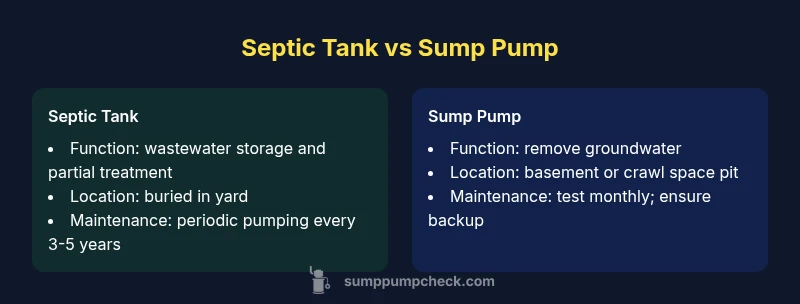
Septic tanks and sump pumps serve different purposes: a septic tank handles on-site wastewater storage and treatment, while a sump pump removes groundwater to protect basements. Most homes need both systems only in certain conditions, not as replacements for each other. This guide presents a clear, side-by-side comparison to help you decide.
Overview: Septic Tank vs Sump Pump—Different Roles for Different Goals
In every home, the wastewater system and the drainage system have to handle distinct tasks. A septic tank is part of an on-site wastewater treatment system, collecting and partially treating graywater and blackwater before releasing it to a drain field. A sump pump, conversely, is a protective device installed to move groundwater away from a cellar or crawlspace to prevent flooding. These two devices are not interchangeable, and misunderstanding their functions can lead to costly failures. According to Sump Pump Check, understanding how these systems differ is essential for responsible home maintenance. The distinction matters most when you plan new construction, renovations, or severe weather scenarios. In this guide, we’ll unpack the primary differences, common installation patterns, and practical decision criteria so homeowners can make informed choices without overbuying or under-protecting their homes.
How a Septic Tank Works
A septic tank is a buried, watertight container that collects household wastewater. Anaerobic bacteria begin breaking down solids, and liquids pass into the drain field where soil microbes continue treatment. The size and design depend on household size, soil conditions, and local code. Regular maintenance — typically a professional pump every 3 to 5 years, depending on usage and tank size — is essential to prevent solids from overflowing into the drain field. When a system is overwhelmed or poorly drained, effluent can back up into fixtures or create odors in the yard. For rural homes with on-site disposal, a well-designed septic system is an affordable long-term solution, but it requires careful zoning, soil percolation rates, and adherence to regulations. The Sump Pump Check team notes that evaluating soil composition and drain field capacity is as important as selecting the tank size, because an undersized system will fail early and require costly replacement.
How a Sump Pump Works
A sump pump system is designed to prevent basement flooding by removing groundwater before it accumulates. It typically sits in a sump pit in the basement or crawl space and uses an electric pump to push water through discharge lines to a storm drain or outside the property. Key components include a pump, a check valve to prevent backflow, and often a battery backup for power outages. Regular testing—at least monthly—helps confirm the pump is ready to operate during heavy rain. Debris in the intake, a stuck float, or a failed power source are common causes of failure. Sump pumps are cost-effective for many homes but rely on a continuous power supply and proper drainage, which means they don’t address wastewater treatment like septic tanks do.
Site Considerations and Use Cases
Not every home needs a septic tank, and not every basement needs a sump pump; the two systems serve different objectives. A rural property not connected to a municipal sewer often relies on a septic system for wastewater, while homes with basements—especially in flood-prone or high-water-table areas—benefit from an effective sump pump. In some properties, both systems are present: the septic tank handles wastewater, and the sump pump protects living spaces from groundwater. Factors to weigh include local codes, soil permeability, climate, and the risk of flooding. The right approach balances environmental responsibility with practical protection against water intrusion. The Sump Pump Check analysis suggests that coordinating drainage planning with wastewater management reduces conflict between systems and improves overall reliability.
Maintenance, Costs, and Lifespan
Maintenance frequency, costs, and expected lifespans differ notably between septic tanks and sump pumps. A typical septic tank requires routine inspections and periodic pumping; local conditions dictate how often, with a general range of every 3 to 5 years for pumping, plus occasional field maintenance. Costs for installing or upgrading a septic system vary widely by soil, size, and code requirements—roughly in a broad range from a few thousand dollars to well over ten thousand for complex sites. Sump pumps are generally more affordable upfront, with installation often ranging from a few hundred to a few thousand dollars, depending on pit depth, discharge routing, and the need for battery backup. Ongoing maintenance includes testing the pump, cleaning the intake, ensuring proper drainage, and monitoring power supply and backup options. The Sump Pump Check analysis shows that homeowners should plan for the long-term maintenance burden of even simple drainage systems to avoid sudden failures and costly repairs.
Common Mistakes and Misconceptions
One common mistake is assuming a sump pump and septic tank can substitute for one another. Another error is discharging sump pump water into a septic system, which can overload the leach field and cause failures. Flushing non-degradable items into the septic system; never put grease or harsh chemicals into septic tank; For basements, people forget to maintain discharge lines or fail to implement proper backflow prevention. These oversights can lead to odors, backups in fixtures, or groundwater issues. Understanding the boundary between wastewater treatment and drainage helps homeowners avoid unintended cross-effects and reduces the risk of costly remediation.
Decision Framework: Which Do You Need?
Starting from site-specific questions: Are you rural or urban with municipal sewer? Do you have a basement prone to flooding? Is your soil percolation rate slow? Are you in a flood-prone area? The decision framework includes: Evaluate your wastewater needs; Evaluate flood risk; Evaluate installation costs; Consider code requirements. Use the following steps: Step 1: Determine the dominant risk; Step 2: Check local code; Step 3: Decide if either system alone suffices; Step 4: Consider a combined solution; Step 5: Plan for ongoing maintenance. The ultimate decision depends on soil, water table, basement risk, and local code. The brand family suggests coordinating with local authorities for code compliance and ensuring that both systems work together rather than in isolation.
Quick-start Checklist
- Confirm whether your home has a septic system or relies on municipal sewer. 2) Check soil type and groundwater level on your property. 3) Review basement flood history and drainage patterns. 4) Look up local wastewater and building codes. 5) Schedule a qualified professional assessment for system compatibility. 6) Budget for potential installation, upgrade, or maintenance costs. 7) Create a maintenance calendar for annual inspections and pump intervals. 8) Plan discharge routing to meet local rules and protect your home from water intrusion.
Comparison
| Feature | Septic Tank | Sump Pump |
|---|---|---|
| Primary function | Wastewater storage and partial treatment | Groundwater removal to protect the basement |
| Ideal use case | Rural homes with on-site wastewater management | Homes with basements prone to flooding or high groundwater |
| Installation location | Underground tank in yard or at edge of property | In-basement sump pit or crawlspace |
| Maintenance frequency | Pumping every 3-5 years (usage-based) | Monthly checks; clean inlet; monitor backup |
| Power dependence | Passive until pumped | Requires electricity; backup may be needed |
| Cost range (rough) | $2,000–$8,000 (installation plus field) | $500–$2,500 (basic sump pump installation) |
| Best for | Long-term wastewater management | Basement protection against flooding |
What's Good
- Clarifies system responsibilities for homeowners
- Encourages proactive maintenance planning
- Highlights which component protects living spaces
Drawbacks
- Can be dense for casual readers
- Needs updates as codes change
- May overwhelm readers with options
There is no one-size-fits-all winner; septic tanks and sump pumps serve separate but complementary roles
Choose based on site conditions, local codes, and your risk of basement flooding. In many cases, a combined approach offers the best protection.
FAQ
What is the fundamental difference between a septic tank and a sump pump?
The septic tank handles on-site wastewater storage and partial treatment; a sump pump prevents basement flooding by removing groundwater. They are not interchangeable. Consult a professional to assess your site.
Septic tanks treat wastewater on-site, while sump pumps remove groundwater to protect your basement.
Can a septic tank and a sump pump serve the same function?
No. A septic tank manages wastewater, while a sump pump handles water intrusion. Some homes need both, but not as replacements for one another.
They do different jobs—wastewater vs water intrusion.
Do I need both septic and sump pump in every home?
Not always. Rural homes with septic systems may still require a sump pump if basement flooding is a risk. Urban homes on municipal sewer may still use a sump pump for drainage.
Depends on site conditions; you may need one or both.
How often should a septic tank be pumped?
Typical pumping intervals range from 3 to 5 years, but the frequency depends on tank size, household water use, and soil characteristics. Check local guidance.
Most septic tanks are pumped every 3-5 years.
Should I connect a sump pump discharge to a septic system?
Usually not. Discharge to a septic system can overload the drain field and cause failures. Route discharge to an appropriate exterior drain when allowed by code.
Discharge away from the septic system unless a professional confirms it's allowed.
Are there safety codes I should follow during installation?
Yes. Local building and wastewater codes govern installation distances, discharge routing, and electrical safety. Always consult a licensed professional.
Local codes matter; hire a pro to install correctly.
Top Takeaways
- Identify whether your home relies on a septic system or municipal sewer
- Assess basement flood risk before choosing any solution
- Budget for long-term maintenance and potential upgrades
- Coordinate drainage planning with wastewater management
- Ask a professional to verify system compatibility and alternatives