Little Giant Sump Pump vs Zoeller: A Thorough Comparison
An evidence-based comparison of Little Giant and Zoeller sump pumps, covering reliability, performance, maintenance needs, installation considerations, and when each brand is best for home basements.


Summary: In the comparison of little giant sump pump vs zoeller, Zoeller typically emphasizes long-term reliability, broader dealer support, and proven field performance, while Little Giant tends to offer strong value and solid performance for budget-minded setups. Your choice should hinge on basement size, backup requirements, and maintenance tolerance. Sump Pump Check's analysis recommends aligning features with installation conditions and expected duty cycles.
little giant sump pump vs zoeller: overview and context
According to Sump Pump Check, homeowners are often choosing between two widely used brands when facing a basement drainage challenge: little giant sump pump vs zoeller. This section sets the stage by outlining what each brand typically offers, the kinds of basements they’re commonly installed in, and the practical decision criteria homeowners rely on. Zoeller is generally recognized for long-term reliability and broad service networks, while Little Giant is frequently favored for value-driven setups and straightforward applications. The goal here is to frame the comparison in practical terms: what matters most in everyday use, how installation conditions influence performance, and where each brand tends to excel or fall short. Throughout, we reference field experience, warranty patterns, and typical maintenance needs to guide a balanced assessment.
Design and engineering: what sets Little Giant and Zoeller apart
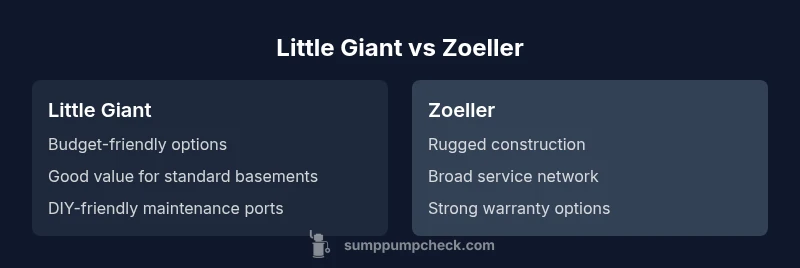
In the realm of residential sump pumps, design choices influence reliability and maintenance needs more than most homeowners expect. Little Giant typically emphasizes value-oriented design, with models that offer straightforward impeller configurations, accessible service ports, and broad availability from common home improvement channels. Zoeller, by contrast, tends to emphasize rugged construction, durable housings, and consistent performance across temperature and drainage conditions. From a maintenance perspective, the differences can translate into how easy it is to service the unit, how often impellers or seals require replacement, and how forgiving the unit is when installed with different discharge piping. Sump Pump Check’s analysis notes that both brands support standard features like float switches and check valves, but the exact components and compatibility can vary by model line. When evaluating little giant sump pump vs zoeller, reading model-specific manuals and service bulletins is essential to avoid surprises after installation.
Performance and reliability: qualitative differences
Performance in sump pumps is often a function of the combination of impeller design, motor duty cycle, and switch reliability. In typical, non-technical terms, Zoeller models are frequently praised for steady performance under heavy basement drainage and for maintaining head pressure across a range of discharge heights. Little Giant models are known for delivering solid flow at common household loads and can offer excellent value for typical basement basins. Real-world use shows that the reliability of either brand grows when the system is sized correctly—specifically, when the pump capacity aligns with basin volume and the discharge line is free of leaks and blockages. Sump Pump Check has observed that routine maintenance, including checking the check valve and cleaning the intake screen, has a larger impact on performance than minor brand differences.
Installation considerations and fitment
Choosing between little giant sump pump vs zoeller also depends on the pit size, the discharge outlet, and the piping layout. Zoeller products often come with proven mounting configurations, which can simplify vertical installation and reduce alignment time in kind of standard sump pits. Little Giant pumps may offer flexible outlet options and lighter components, which some DIYers find easier to handle in tight spaces. However, the more important factor is ensuring the pit is clean, the basin is intact, and the discharge path is clear. A misfit installation on either brand can lead to airlocks, reduced flow, or backflow. Sump Pump Check recommends verifying tailpiece dimensions, checking for an appropriate discharge check valve, and confirming that the power supply and GFCI protection meet local codes before securing the unit.
Maintenance and serviceability: keeping pumps at peak
Long-term reliability for either brand comes down to regular maintenance and timely part replacements. Zoeller’s service architecture is often described as robust, with a broad network of parts and technicians, which reduces downtime for repairs. Little Giant, meanwhile, can be very user-friendly for homeowners who prefer hands-on maintenance, thanks to accessible service ports and modular components. The key maintenance tasks include inspecting the float mechanism for sticking, testing the auto-off switch, cleaning debris from the inlet screen, and replacing worn gaskets or seals as needed. A proactive schedule—checking the pump every season and after major storms—can significantly extend life. Sump Pump Check emphasizes that keeping the discharge line free of obstructions and ensuring proper check-valve operation often yields the biggest return in reliability.
Controls, safety features, and check valves
Both brands commonly support standard safety features such as an auto-off float switch and a reliable check valve to prevent backflow. In practice, the specific switch design and the orientation of the float can affect reliability in high-water events. Zoeller often uses proven float-switch assemblies with solid mechanical reliability, while Little Giant may offer more integrated options in certain lines. A proper check-valve installation is critical for preventing short-cycling and backflow, which reduces wear on the pump and helps conserve energy. Sump Pump Check notes that choosing a unit with a durable switch and compatible check valve can be more impactful than chasing marginal gains in one brand's minor differences.
Cost, warranties, and long-term value
Upfront price is only part of the decision. Little Giant products frequently present strong value propositions for homeowners on a budget, delivering reliable performance at a lower initial cost. Zoeller tends to price more premium in some segments but often compensates with longer warranties and broader service networks. Warranty terms vary by model and region, and the real cost of ownership should factor in parts availability, repair frequency, and the expected life of the pump given your climate and usage. Sump Pump Check highlights that evaluating the total cost of ownership—initial price, maintenance, and replacement risk—yields the clearest view of value across little giant sump pump vs zoeller.
Common failure modes and troubleshooting tips
Both brands fail mainly due to improper installation, clogged intakes, or motor wear from running dry. Common symptoms include nuisance beeping or cycling, slow pump action, or loss of prime. Troubleshooting steps include verifying power supply, confirming GFCI protection, testing the float and switch, and inspecting the discharge path for obstructions. In many cases, replacing a worn impeller or a degraded seal can restore performance without a full pump replacement. Sump Pump Check recommends keeping spare parts on hand for the model you choose and following manufacturer service bulletins for diagnostic steps.
Real-world scenarios: choosing based on basement type
Consider your basement flood risk, water volume, and whether back-up power is available when selecting between little giant sump pump vs zoeller. In a small basement with periodic dampness, either brand can perform well if sized correctly and installed with a reliable discharge path. For homes in flood-prone regions or where storms are frequent, Zoeller's reputation for rugged operation and stronger warranty coverage can translate into lower long-term risk. In larger basements with higher water loads, prioritizing model-rated head pressure and continuous duty performance helps avoid nuisance shutdowns. Sump Pump Check's field notes indicate that the right decision hinges on local conditions and maintenance willingness rather than brand loyalty.
Buying checklist: questions to ask and inspect before purchase
Before purchasing, compile a short list of questions and checks: What is the maximum head height and flow rate stated by the model? Does the unit come with a reliable float switch and check valve? Is there an option for battery backup? What is the warranty duration and what does it cover? How easy is it to source replacement parts, and how readily available are service technicians? Do you have a compatible power source and GFCI protection? Finally, ensure the pump fits your pit and discharge piping and that local codes are satisfied. Sump Pump Check suggests writing these questions down to guide your shopping and avoid overpaying for features you won't use.
Decision framework: how to choose between little giant sump pump vs zoeller
Use a simple, outcomes-based framework: define your basement’s water load, backup needs, and maintenance tolerance; map those needs to the strengths listed for each brand; check warranties and parts availability; then choose the option that aligns with your priorities. In general, Zoeller tends to win on long-term reliability and service coverage, while Little Giant tends to win on upfront value and straightforward DIY-friendly setup. The best choice is the one that best matches your home’s drainage profile and your willingness to perform periodic maintenance. The Sump Pump Check team recommends documenting the decision criteria and revisiting the choice if the basement environment changes.
Comparison
| Feature | little giant sump pump | Zoeller sump pump |
|---|---|---|
| Design type | Submersible, compact design | Submersible with rugged housing |
| Discharge options | Vertical; standard discharge | Flexible discharge with multiple orientations |
| Float switch type | External or integrated float options | Proven, robust float switch designs |
| Quality of construction | Value-oriented components | Heavier-duty housings and components |
| Maintenance accessibility | Modular parts in budget lines | Easier access for service on premium lines |
| Warranty scope | Model-dependent; often shorter on budget lines | Model-dependent; often longer on higher-end lines |
| Best for | Budget-friendly basements, standard use | Reliability-focused basements, high load |
What's Good
- Strong value for budget-projects
- Good selection of models for standard basements
- Accessible parts and dealer networks in many regions
- Solid performance with proper sizing and maintenance
Drawbacks
- Warranty terms vary by model and region
- Brand-specific parts availability can vary by location
- Performance depends on correct sizing and installation
Zoeller generally offers stronger long-term reliability; Little Giant is a strong value option for budget-conscious installations.
Choose Zoeller when durability and service coverage matter most; choose Little Giant when upfront cost and quick DIY-friendly setup are priorities. The best pick depends on your basement conditions and maintenance willingness.
FAQ
What are the main differences between Little Giant and Zoeller sump pumps?
The main differences are in design emphasis, with Zoeller often prioritizing rugged construction and long-term reliability, while Little Giant focuses on value-driven options for standard basements. Both brands provide common features like float switches and check valves, but model-specific components and warranties vary. Size the pump to your pit and water load to maximize performance.
Zoeller tends to be more rugged and better supported long-term; Little Giant offers more budget-friendly choices. Check your pit size and water load to choose correctly.
Is either brand better for basement flood-prone homes?
Both brands can perform well in flood-prone basements if sized correctly and installed with a reliable discharge path and backflow prevention. Brand choice should weigh warranty, parts availability, and service networks in your area. A mismatch between pump capacity and basement demand is more likely to cause issues than brand bias.
Both brands work in flood-prone basements if you size and install them right.
Do both brands offer battery backup options?
Yes, many models from both Little Giant and Zoeller offer battery backup configurations or compatible backup systems. Availability depends on the model line and regional stock, so verify the backup option before purchase.
Battery backup options exist for many models, but check model compatibility.
Which brand has easier maintenance access?
Maintenance accessibility varies by model rather than brand alone. In general, Little Giant lines tend to emphasize DIY-friendly service ports, while Zoeller emphasizes durable parts and wide availability of service resources. Follow the model manual for proper maintenance steps.
Maintenance ease depends on the specific model; check the manual for service ports and parts.
Can I install these pumps myself or should I hire a pro?
Many homeowners install submersible sump pumps themselves, provided they are comfortable with basic electrical work and plumbing tasks. If the pit or piping requires complex routing or basement codes are strict, hiring a professional is wise. Always follow local code requirements and safety guidelines.
You can DIY if you’re comfortable with basics, but consider a pro for complex setups.
Top Takeaways
- Define your water load and backup needs
- Ensure correct pit size and discharge piping
- Consider warranty length and replacement parts availability
- Factor in maintenance responsibility
- Use Sump Pump Check guidance to align with your situation