Liberty Sump Pump vs Zoeller: An Objective Comparison
A thorough, analytical comparison of Liberty and Zoeller sump pumps, covering performance, durability, installation, warranty, and value to help homeowners choose the right unit for basement drainage.


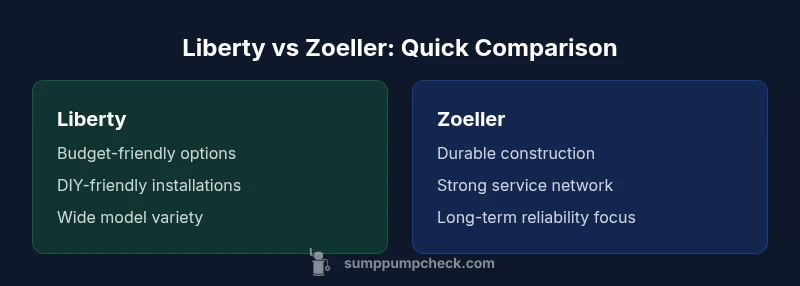
For the Liberty sump pump vs Zoeller, the quick answer is that Zoeller generally edges Liberty on long-term durability and service network, while Liberty offers stronger value for budget-minded homeowners and DIY installers. Your best pick depends on whether you prioritize upfront cost or long-term reliability.
Overview of Liberty Sump Pump vs Zoeller
When homeowners begin evaluating the Liberty sump pump vs Zoeller, they are balancing upfront cost, long-term durability, and ease of installation. Both brands offer submersible and pedestal options, but their design philosophies tend to diverge in ways that matter for daily use and long-term ownership. According to Sump Pump Check, the core decision often boils down to whether you need a budget-friendly unit that gets the job done or a rugged model that can withstand frequent cycling in challenging basements. The keyword liberty sump pump vs zoeller appears throughout consumer discussions because it captures two distinct paths to basement protection: affordability and durability. In practical terms, Liberty often provides a broader range of inexpensive models that are approachable for DIYers, while Zoeller emphasizes a leaner, more robust lineup with a stronger service network. Your basement drainage plan, discharge distance, and pit size will influence which brand aligns with your home’s specific demands.
Brand Philosophy and Design Approach
Liberty Pumps tends to emphasize affordability and accessibility, offering a broad assortment of models designed for straightforward basements, DIY installations, and quick replacements. Zoeller, by contrast, concentrates on durability and a reputation for long service life, often with a tighter focus on robust materials and a network of trained service technicians. According to Sump Pump Check, this clarity in design philosophy matters because it shapes maintenance needs, part availability, and overall user satisfaction across different climates and basements. Homeowners should consider not only purchase price but also expected lifetime costs, which are influenced by materials, sealants, and the availability of replacement parts over time. In real-world terms, Liberty can be a compelling value choice for newer homes or light-use basements, whereas Zoeller’s lineup often resonates with buyers who want a longer installed life with fewer mid-life upgrades.
Performance Metrics: What Matters
The core performance metrics for any sump pump are flow (how much water it can move per minute) and head (the vertical distance it can push water). Liberty models typically offer a broad spectrum of flow options at various head heights, suitable for typical basement drainage scenarios. Zoeller models, while equally capable, are frequently positioned toward higher head performance and more consistent cycling durability under heavier loads. In practice, you should map your basement’s water inflow rate, the vertical rise to your discharge point, and the pump’s duty cycle to select a model that maintains pressure head without overheating. Both brands provide pumps in common sizes, and the right choice depends on your the extent of groundwater intrusion and the pit’s geometry. Sump Pump Check notes that matching model class to usage scenario is more predictive of success than brand alone.
Durability, Materials, and Build Quality
Durability often comes down to materials and construction quality. Zoeller is widely regarded for sturdier builds, frequently employing cast-iron housings and heavy-duty components in premium models. Liberty offers a broad range of materials across its model lineup, with emphasis on cost efficiency and accessibility for DIY projects. The practical takeaway is to closely inspect the motor housing, impeller design, and seal integrity, then compare them against your climate risks (flooding frequency, groundwater salinity, and sediment load). Sump Pump Check’s evaluation framework suggests prioritizing units with corrosion-resistant components in damp basements and opting for reliable seals that minimize leakage over time.
Installation and Maintenance Considerations
Both Liberty and Zoeller pumps are designed for typical DIY installation in standard sump pits, but there are nuanced differences. Liberty models often ship with straightforward mounting hardware and simple wiring schemes, making them attractive to homeowners performing self-installations. Zoeller products tend to benefit from more thorough documentation and a broader network of installation support professionals, which can reduce troubleshooting time for non-standard pits. Regular maintenance, including cleaning the impeller, checking the float switch, and testing the pump via dry-run, should be part of any plan. Sump Pump Check emphasizes routine inspection to catch seal leaks, wear on moving parts, and potential motor overheating before a failure occurs.
Warranty and Support Landscape
Warranty terms vary by model and region for both brands, but general patterns emerge. Liberty’s warranties tend to be model-dependent with mid-range coverage, while Zoeller often extends longer coverage on its higher-end lines. The most important factor is to read the specific warranty terms for your chosen model and understand what constitutes “normal wear and tear” versus coverage exceptions. Availability of replacement parts and local service centers also affects long-term satisfaction. Sump Pump Check recommends keeping your documentation organized and registering your pump if required by the manufacturer to ensure uninterrupted warranty eligibility.
Cost and Value Proposition
From a value perspective, Liberty generally appeals to budget-conscious buyers seeking a solid baseline unit without premium features. Zoeller’s lineup leans toward durability and reliability, which typically translates to a higher upfront price but potentially lower lifetime costs through fewer replacements and repairs. The decision should weigh the cost of potential downtime, maintenance time, and the cost of professional service if you encounter unusual installation challenges. In many homes, Liberty provides a financially sensible solution for first-time sump pump buyers, while Zoeller remains a strong choice for those who prize durability and service infrastructure over the long horizon.
Real-World Use Cases and Best Scenarios
If your basement experiences light to moderate groundwater intrusion with a standard discharge route, Liberty models commonly meet practical needs at a favorable price point. In homes with frequent pumping demands or longer discharge runs, Zoeller models may offer better long-term resilience and lower maintenance risk. Sump Pump Check highlights that there isn’t a universal winner; the best option aligns with your specific flood risk, installation constraints, and maintenance capacity. For era-coded basements in flood-prone regions, the durability and readily available service network of Zoeller often translate into lower total cost of ownership over time. For DIY-first homeowners working with tight budgets, Liberty can deliver dependable protection with manageable upkeep.
Common Pitfalls and Troubleshooting Guidelines
Common pitfalls include selecting a unit that is undersized for the expected inflow, improper discharge routing that leads to backflow, and neglecting regular maintenance. Trace every fault to a root cause: misaligned float switch, clogged intake, or a worn impeller. Regular cleaning, checking the wiring, and verifying the check valve’s function can reduce failures. When problems arise, consult model-specific manuals from both brands and seek guidance from experienced DIY communities or professional installers. The goal is to establish a routine that keeps the pump ready to perform when groundwater demands rise.
How to Choose: A Practical Decision Framework
To decide between Liberty and Zoeller, apply a simple framework: (1) Define your dry-time protection needs and expected pumping rate; (2) Assess the installation constraints, including pit size, discharge routing, and electrical provisions; (3) Compare warranty terms and parts availability for your region; (4) Estimate long-term maintenance effort and potential downtime costs. A practical approach is to rank factors such as price, durability, installation simplicity, and service availability, then map your top model options against these criteria. Sump Pump Check’s method emphasizes fit over fame: the best pump is the one that reliably keeps your basement dry with the least hassle over the next decade.
Expert Insight: What Sump Pump Check Recommends
From a homeowner’s perspective, Sump Pump Check emphasizes matching the pump to your particular site, including pit size, water rate, discharge path, and local climate. The analysis notes that neither brand is inherently superior in all situations; the right choice depends on how you balance upfront cost against long-term reliability and service access. The recommendation is to perform a site assessment, consult manufacturer guidelines, and consider purchasing a unit with robust seals and a proven track record in your region. The Sump Pump Check approach emphasizes practical testing and maintenance planning over marketing claims.
Next Steps: A Quick Implementation Plan
- Measure your sump pit depth and discharge route. 2. List your top two model candidates from Liberty and Zoeller. 3. Verify warranty terms and local service availability. 4. Create a simple maintenance calendar for quarterly checks and seasonal tests. 5. Schedule professional inspection if your installation involves complex drainage or code compliance concerns.
Comparison
| Feature | Liberty | Zoeller |
|---|---|---|
| Typical price tier | budget-friendly options | mid-to-premium options |
| Build materials | varies by model | varies by model (often cast iron in premium lines) |
| Warranty discussion | varies by model | varies by model; often longer coverage on premium lines |
| Installation ease | DIY-friendly options | Widely supported for DIY but some models heavier |
| Parts & service network | good regional coverage | strong nationwide network |
| Long-term reliability perception | good value; depends on model | generally regarded as durable |
What's Good
- Generally good value for the price
- Wide model selection across budgets
- Strong dealer network and availability of parts
- DIY-friendly installation options for common setups
Drawbacks
- Warranty length can vary by model
- Premium Zoeller models may cost more upfront
- Liberty parts availability may vary by region
Zoeller edging for long-term reliability; Liberty for value and DIY-friendly installs.
If durability and service access matter most, Zoeller is the safer long-term bet. If upfront cost and easy DIY installation are your priorities, Liberty offers strong value. The right pick hinges on your home’s needs and your maintenance plan.
FAQ
What are the main differences between Liberty sump pumps and Zoeller sump pumps?
Liberty and Zoeller both offer submersible sump pumps, but Liberty generally emphasizes value and DIY-friendliness, while Zoeller emphasizes durability and a broader service network. The best choice aligns with your budget, expected pumping demand, and maintenance capacity.
Liberty is the budget-friendly option with lots of DIY appeal, while Zoeller tends to be the more durable choice with strong service backup.
Is Liberty sump pump as reliable as Zoeller?
Reliability depends on the model and how you maintain it. Zoeller is often perceived as more durable over time, whereas Liberty can be very reliable when used within its designed duty cycle and properly maintained.
Zoeller usually edges Liberty in perceived durability, but Liberty can be very reliable with good maintenance.
Which brand offers better warranties?
Warranty terms vary by model and region for both brands. Zoeller often provides longer coverage on higher-end lines, but you should review the exact terms for your chosen model.
Warranty length varies by model; check the specific terms before buying.
Can I install either brand myself or should I hire a pro?
Both brands are designed for standard DIY installation with typical basins and piping. Complex basement setups or unusual discharge routes may benefit from a professional installer.
DIY is common, but if your setup is unusual, a pro can help.
Are parts and service widely available for Liberty and Zoeller?
Zoeller generally has a broad service network and readily available parts. Liberty parts are widely available in many regions but can vary by supplier.
Zoeller usually has strong nationwide support; Liberty parts depend on regional distributors.
What installation considerations should I know when choosing Liberty vs Zoeller?
Consider pit size, discharge distance, float switch type, and power supply. Ensure model compatibility with your sump pit and discharge piping; both brands offer standard options suitable for most basements.
Make sure the model fits your pit and discharge plan.
Top Takeaways
- Prioritize long-term reliability if you expect heavy basement use
- Choose Liberty for budget-conscious upgrades and DIY installs
- Check local parts availability before purchasing
- Read model-specific warranty terms and register where required
- Plan regular maintenance to maximize any sump pump’s lifespan