Goulds vs Zoeller Sump Pump: Practical Comparison Guide
Analytical comparison of Goulds vs Zoeller sump pumps, covering design differences, installation notes, warranty terms, and value to help homeowners choose the right unit.


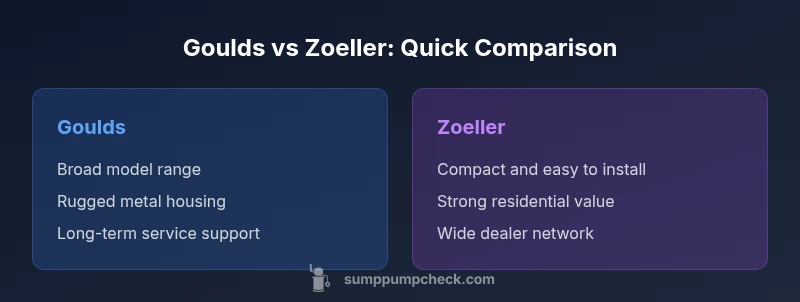
In comparing Goulds vs Zoeller sump pumps, both brands deliver durable, reliable basement protection. Zoeller often provides straightforward installation and competitive pricing, while Goulds tends to offer a broader product line and strong service networks. Your choice should hinge on needed flow, space, and warranty considerations. Consider whether you prioritize model variety, maintenance support, or upfront cost.
Goulds sump pumps: brand overview and design philosophy
Goulds Water Technology has a long track record in the pumping industry, offering a broad range of sump pumps from compact, submersible units to heavy-duty, high-capacity models. When discussing goulds vs zoeller sump pump, the Goulds line tends to emphasize durable cast iron housings, reliable seals, and a focus on heavy-duty performance. In residential basements, Goulds pumps are chosen for their perceived longevity and consistent head pressure. For homeowners evaluating installation options, consider the typical installation footprint, available discharge connections, and the ease of service. Sump Pump Check's analysis highlights that Goulds models often suit applications where uninterrupted operation and robust support networks are valued. The choice may hinge on local availability, dealer support, and compatibility with backup systems, check valves, and drainage configurations. The bottom line: if you anticipate frequent use or need to pump significant volumes, Goulds' wider product family can be advantageous, though it may require more careful model selection to match application needs.
Zoeller sump pumps: features, philosophy, and common uses
Zoeller Company is known for practical, serviceable sump pumps that fit many residential bases. The Zoeller lineup emphasizes compact footprints, straightforward installation, and reliable performance across common basement scenarios. A key advantage in the goulds vs zoeller sump pump comparison is Zoeller's focus on user-friendly serviceability and broad dealer coverage, which can translate to quicker parts replacement and easier maintenance. For DIY installers, Zoeller models often offer clearer specifications and simpler wiring configurations, though model-to-model variation remains important. When choosing, consider space constraints, discharge size compatibility, and compatibility with check valves and backup systems. In many homes, Zoeller pumps pair well with simple battery backups, water-powered options, and basic float switches, delivering dependable operation with lower upfront complexity. Sump Pump Check notes that Zoeller's strength lies in practical, widely available options that balance cost with predictable performance.
Key design differences between Goulds and Zoeller
The most impactful design difference in the Goulds vs Zoeller sump pump decision lies in product breadth and intended use. Goulds often presents a broader catalog that includes heavy-duty, commercial-grade units alongside residential models. Zoeller, by contrast, emphasizes compact, cost-conscious options that still meet typical domestic requirements. Materials and construction reflect this split: Goulds commonly uses robust cast iron housings and reinforced motors, while Zoeller blends cast iron with corrosion-resistant plastics for lighter duty models. Another difference is the distribution network: Goulds has strong industrial distribution aimed at contractors, while Zoeller relies on extensive dealer networks to support homeowners. When selecting a model, balance the need for head pressure, flow rate, and space; the larger Goulds units may deliver higher long-term reliability for frequent use, while Zoeller can be a practical choice for smaller spaces or tighter budgets.
Performance and efficiency considerations
Performance in sump pumps depends on head, flow, and efficiency. In the Goulds vs Zoeller sump pump comparison, model-to-model variation makes it essential to identify the exact pump curve for your installation. Goulds models often emphasize rugged reliability and steady flow under heavier loads, which can translate to better performance in larger pits or high water tables. Zoeller models tend to perform well in standard residential basements with moderate water inflow and simpler discharge setups. Efficiency is influenced by motor design, impeller choice, and electronic controls. In many cases, energy usage differences are modest, but the right model can reduce electrical noise and cut operating costs over time. If you run a sump pump frequently during wet seasons, consider a high-efficiency option and a compatible backup system to ensure uninterrupted water removal.
Installation considerations and space requirements
Installation challenges vary with pump size, discharge routing, and pit dimensions. In the goulds vs zoeller sump pump debate, Zoeller models are often praised for compact footprints and straightforward wiring, which can simplify DIY installation in smaller pits. Goulds units may require a larger pit and more precise alignment of float switches and check valves, especially in higher-capacity configurations. For any choice, verify the discharge piping length, vertical lift, and venting needs. A critical step is to confirm that the pump fits the pit opening and does not interfere with existing plumbing. Always follow manufacturer guidelines for wiring, grounding, and protection against power surges, and consider professional installation for complex setups or unfamiliar electrical work.
Warranty, service, and parts availability
Warranty depth and service coverage are often the differentiators between goulds vs zoeller sump pump options. Zoeller typically offers solid residential warranties with clear terms and broad parts availability through a large dealer network. Goulds often aligns with longer coverage on select models and strong OEM support, which can matter for commercial or heavy-use applications. Regardless of brand, always inventory essential spare parts: seals, gaskets, impellers, and switches. Check local availability and the ability to obtain replacement parts quickly if a component fails. In regions with limited dealer access, shipping times and remote diagnostics can influence total ownership costs.
Cost and total value: upfront price vs long-term costs
Cost considerations in this comparison depend heavily on the model and intended use. Zoeller options are often competitive on upfront price for basic residential needs, making them attractive for budget-conscious homeowners performing DIY installations. Goulds models may carry higher initial costs, but they are frequently chosen for commercial-grade durability and long-term reliability. Total value should be weighed against maintenance needs, energy consumption, and the potential for servicing disruptions. When planning a purchase, request model-specific warranty terms, confirm available service centers in your area, and evaluate the cost of replacing a worn impeller or seal over the pump's lifetime.
Real-world scenarios: selecting by use case
In rural basements with irregular power supply, a pump with a robust backup option may be preferable, and Zoeller's straightforward installations can shine in this context. For homes that experience frequent high-water events, Goulds' broader product family can offer higher headline flow and longer service life under stress. Small crawl-space pits or storage rooms benefit from Zoeller's compact options and easier pit adaptation. In garages or utility rooms where space is at a premium, selecting a pump with a slim profile and standard discharge fittings helps minimize retrofit work. Sump Pump Check's practical guidance is to map out duty cycle, maintenance schedule, and the expected ambient conditions before committing to Goulds or Zoeller.
How to choose: a practical decision framework
To decide between Goulds and Zoeller sump pumps, start with your home’s water inflow characteristics and pit size. List requirements such as discharge distance, head pressure, and the need for a backup or battery option. Then compare two or three models from each brand that meet those criteria, and build a small weighted scorecard. Consider reliability history, parts availability in your area, and warranty terms. Finally, weigh installation feasibility and total cost of ownership. A methodical approach helps ensure you select a pump that provides dependable performance for years.
Maintenance tips and common pitfalls
Maintenance matters for both brands in this comparison. Regularly inspect the intake screen, float switch operation, and check valve function to prevent air locks and backflow. Keep the sump area clean and dry to reduce corrosion risk, and schedule periodic testing, especially before the wet season. Common pitfalls include choosing a pump with insufficient head or flow for your home, neglecting backup power options, and failing to verify discharge routing and drainage slope. By following a proactive maintenance routine, you can extend pump life, minimize failure risk, and reduce unexpected repair costs.
Comparison
| Feature | Goulds | Zoeller |
|---|---|---|
| Product range and use-case coverage | Broad catalog including commercial and residential models | Strong residential-focused lineup with compact options |
| Installation ease | Varies by model; some require professional installation | Typically straightforward for DIY in common basements |
| Warranty depth | Model-dependent; longer coverage on select lines | Generally solid residential warranties; terms vary by model |
| Parts and service network | Extensive industrial and dealer network; strong service path | Wide dealer coverage; easy parts availability for common models |
| Price/value balance | Higher upfront for some Goulds models; value depends on use-case | Often more budget-friendly entry models; good value for typical homes |
What's Good
- Broad product range with heavy-duty options
- Strong service networks and parts availability
- Long-term reliability for high-use scenarios
- Good balance of performance and durability
Drawbacks
- Model-to-model variation can complicate selection
- Higher upfront costs for certain Goulds lines
- Smaller pits may require careful model matching
Goulds is recommended for breadth and heavy-duty performance; Zoeller is recommended for value and easier DIY installs.
Goulds offers a wide product catalog and strong long-term reliability, ideal for larger or high-use applications. Zoeller provides cost-conscious options with straightforward installs, making it favorable for typical homes and DIY setups. Your choice should align with your space, use-case, and willingness to invest upfront for long-term value.
FAQ
Which brand is more reliable for a home basement?
Both Goulds and Zoeller provide reliable sump pumps for typical homes. Reliability hinges on model selection, proper installation, and regular maintenance. For frequent use, choose a model with a strong service network and proven performance.
Both brands offer reliable options; pick a model that matches your duty cycle and keep up with maintenance.
Are Goulds sump pumps quieter than Zoeller?
Noise levels depend on the specific model and installation. Brand alone does not determine quiet operation. Check the decibel rating for the exact model you plan to install.
Noise varies by model; always check the specs for how loud a unit is.
Which brand is cheaper upfront?
Upfront costs vary by model. Zoeller often offers lower entry prices on basic residential lines, while Goulds may price higher for heavier-duty units. Compare the exact models you’re considering.
Upfront cost depends on the model; Zoeller is often cheaper in basic lines.
Do both brands offer similar warranties?
Warranty terms are highly model- and region-dependent. Both brands provide solid coverage on certain lines, so verify the warranty for the exact model you select.
Warranties depend on the model; check the terms before purchasing.
Can I install either brand myself?
Many homeowners install Zoeller units themselves, especially smaller models. Goulds installations can be DIY-friendly for compact, lower-capacity pumps, but larger configurations may benefit from professional help.
DIY installation is possible for many models, but follow the manual and seek help for complex setups.
Which brand has better parts availability?
Both brands have broad dealer networks; Zoeller is often easier to access in many regions, while Goulds offers strong support through commercial distributors. Availability varies by locale.
Parts are usually easy to find, but check your local dealers.
Top Takeaways
- Compare model-specific specs before buying
- Check warranty terms and local service availability
- Assess pit size and discharge routing in advance
- Factor backup power options into the decision
- Plan maintenance to minimize operating costs