How Long Can a Sump Pump Be Off: A Homeowner's Guide
Discover how long a sump pump can safely be off, the risks of downtime, and practical backup strategies to protect your basement during storms and outages.


How long can a sump pump be off? There is no single universal limit. In wet conditions, even a few hours without pumping can lead to rising water levels and basement risk. If rain is forecast or power is unreliable, avoid turning it off and use a backup power source. Regular testing and backups are essential.
Why the off-time question matters
Understanding how long can sump pump be off matters for preventing basement flooding. If you're wondering how long can sump pump be off, the answer depends on rainfall forecasts, soil saturation, and whether you have backup power. Some homes can tolerate short outages during dry spells, but active storms dramatically reduce safe off-time. According to Sump Pump Check, maintaining continuous operation during precipitation events is often the best defense. A modern sump system, including a properly sized pump and well-sealed pit, reduces but does not eliminate risk when power or fuel fails. The decision to keep the pump running during a weather event should consider forecasted rainfall, drainage quality, and the presence of a backup power source. Regular testing keeps you aware of potential failures before they become disasters, and a proactive plan reduces panic when weather turns severe. In practice, most homeowners find that short, monitored outages with backup support are more manageable than a full, unplanned stoppage.
Key factors that determine safe off-time
Several variables dictate how long a sump pump can be off without creating a flood risk. First, rainfall intensity and duration directly affect water input into the sump pit. Second, soil saturation and groundwater pressure influence how quickly the surrounding soil can push water into the pit. Third, pump capacity and the discharge path (including check valves and unblocked piping) determine how efficiently water is removed. Fourth, the availability of backup power—battery, generator, or other systems—extends safe off-time dramatically. Finally, the age and condition of components (float switch, seals, wiring) determine reliability. In practice, a thorough assessment of these factors yields a personalized safety window for your home. For homeowners, having clear thresholds and a tested backup plan reduces risk during storms and outages.
Scenario-based guidance: rain vs dry periods
During active rain, a sump pump should maintain operation if possible. If power is out, a battery backup can extend uptime to several hours, but prolonged outages increase flood risk. In dry periods, the system can remain off longer without immediate danger, but periodic checks remain important to verify no leaks or cracks have developed. When a storm is forecast, plan for continuous operation or have a backup power source ready. For homes with poor drainage or high water tables, even small time gaps can lead to measurable water intrusion. The key is proactive planning: know your thresholds, test your equipment, and have a clear action plan for switching to backup power during inclement weather.
Backup power options and their trade-offs
Backup power improves resilience, but each option has trade-offs. A battery backup is compact and quiet, typically running for several hours to half a day depending on pump size and battery capacity. A standby generator provides longer uptime but requires fuel, installation, and an outdoor space. A water-powered sump pump uses house water pressure to operate when power fails, but it is less common and relies on municipal water pressure. Consider your local climate, power reliability, and water usage when choosing a backup strategy. The best approach often combines multiple options: regular battery tests, an automatic transfer switch for a generator, and a check-valve-equipped discharge line to prevent backflow. Regular maintenance remains essential to ensure backups respond when needed.
Maintenance practices that reduce risk when the pump is off
Preventive maintenance lowers the likelihood of an unexpected failure, especially when the unit is not running. Schedule annual inspections of the pump, float switch, seals, and power cords. Test the unit monthly to confirm activation and proper emptying of the pit. Replace worn components and ensure the discharge line is clear and slopes away from the foundation. Install a water alarm or float switch alarm to alert you if water rises in the pit. Keep a battery backup in good condition with periodic voltage checks. A wired alarm connected to a home security system or smart device adds another layer of protection and peace of mind.
How to calculate your risk and plan
Start by mapping your property’s drainage and sump setup. Estimate potential water input during typical storms using local rainfall data, and compare that to your pump’s capacity in gallons per minute. If forecasted input exceeds your capacity, plan to keep the pump running or rely on backups. Create a simple risk matrix: high risk if rainfall is expected to exceed your system’s capacity for more than a few hours with no backup power; moderate risk if backups are available but not fully tested; low risk during dry spells with no abnormal groundwater input. Document your thresholds and rehearse your plan with family members.
Quick preparedness checklist for storms and outages
- Verify backup power source is functional and accessible
- Test pump and float switch for proper operation
- Inspect discharge path for blockages and proper slope
- Install water level alarms in the sump pit
- Keep spare parts and batteries on hand
- Review local weather forecasts and align actions with predicted rainfall
Comparative scenarios for sump pump downtime and risk
| Scenario | Off Time (hours) | Flood Risk | Backup Needed |
|---|---|---|---|
| Active rain with power available | 0-1 | Low to moderate | No backup needed |
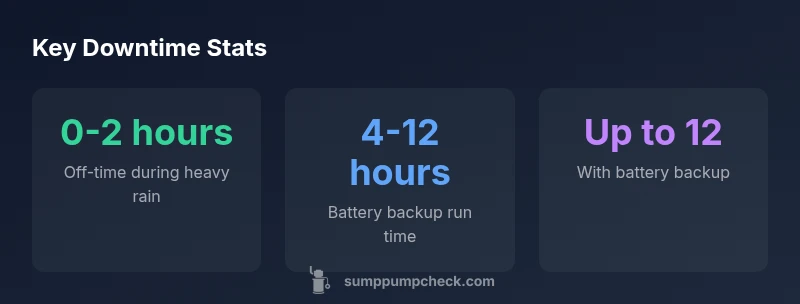
| Active rain with power outage | 0-2 | Moderate to high | Battery backup or generator recommended |
| Dry spell | hours to days | Low | Optional backup if extended outage |
| With battery backup | up to 12 | Low | Required for safety during outages |
FAQ
Can I turn off my sump pump during a power outage?
No, try to avoid turning it off. If you must, have backup power. If your area experiences frequent outages, install a backup battery.
Don't turn it off during a power outage; use backup power. If outages are common, install a battery backup.
How long can a sump pump be off during heavy rain?
There is no universal limit; risk increases quickly with rainfall. If rain is ongoing, keep it on or back up.
There isn't a fixed limit—keep pumping during rain or use a backup.
What should I do if water starts rising in the basement?
Activate backup power, check discharge, and call for professional help if the problem persists.
If water rises, switch to backup power and check the discharge path, call a pro if needed.
Do battery backups extend off-time?
Yes, typically 4-12 hours depending on pump size and battery capacity.
A battery backup can run for several hours, depending on the pump and battery.
Is a generator a good backup?
A standby generator provides longer uptime during extended outages and severe weather.
A generator can keep the pump running during longer outages.
How often should I test my sump pump?
Test monthly and after maintenance; inspect battery and alarm function.
Test it every month and after any maintenance.
“Pumps are only as reliable as their backup and maintenance. Regular testing and a tested backup power plan are essential.”
Top Takeaways
- Assess risk based on weather and drainage
- Keep a reliable backup power source on hand
- Test your sump pump regularly and replace failing parts
- Install alarms and sensors to detect failure quickly
- Plan for outages during storms with a backup strategy