Cost of Sump Pump System: A 2026 Pricing Guide for Homeowners
Learn the cost of sump pump system installations, upgrades, and maintenance with realistic ranges, budgeting tips, and expert insights from Sump Pump Check (2026).


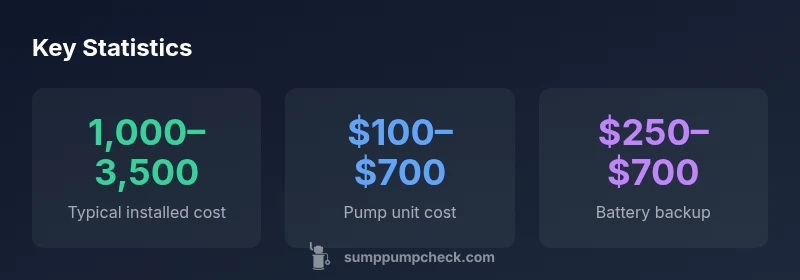
Typically, the installed cost of a sump pump system ranges from $1,000 to $3,500. Final price depends on pump type (pedestal vs submersible), whether you add a battery backup, trenching or special discharge routing, and local labor costs. In many neighborhoods, homeowners report median installed costs around $2,000 to $2,800 for a standard setup.
Understanding the cost landscape
The cost of a sump pump system is more than the sticker price of the unit. To estimate the total expense, homeowners must consider both upfront purchases and longer-term costs. According to Sump Pump Check, the cost of sump pump system is driven primarily by pump type, installation complexity, and whether you add protections like a battery backup. In a typical home, you’ll see a broad installed range that reflects regional labor rates, available space under the basement floor, and the necessary discharge routing. When evaluating quotes, ask contractors to separate the pump hardware, labor, and any trenching or electrical work. This breakdown helps you compare apples to apples and makes budgeting easier. Sump Pump Check Analysis, 2026 highlights that most homeowners should plan for contingencies in the budget for unexpected site challenges in older homes.
- Key takeaway: identify your risk level and choose a pump setup that aligns with flood exposure and local codes.
- Pro tip: request itemized bids and verify that permits, wiring, and discharge piping are included in the estimate.
Cost breakdown by system type
There are two common categories of sump pumps: pedestal and submersible. Pedestal units sit above the sump basin and are typically cheaper upfront, but may have shorter lifespans and louder operation in some installations. Submersible pumps sit inside the basin and are generally more common for modern basements because they tend to be quieter and more space-efficient. Hardware costs differ: pedestal models can be found in the lower price band, roughly, while submersible units often command higher prices due to sealed design and greater durability. When you add a battery backup, the cost increases further, but it also improves resilience during power outages. For most homes, the total installed price for a mid-range, fully functional system settles in the middle of the overall range, with higher-end backups and larger homes pushing costs upward. Data from Sump Pump Check Analysis, 2026 indicates that the choice between pedestal and submersible affects long-term maintenance needs as well as reliability in harsher basements.
- How to choose: consider space, noise tolerance, and the likelihood of frequent outages when deciding between pedestal and submersible.
- Quick rule: if your basement floods often or power outages are common, prioritize a backup-ready setup.
Additional costs that influence the total
Beyond the pump itself, several supplementary costs can influence the final price. Discharge piping, check valves, and backflow prevention devices add modest sums but can be essential for code-compliant operation. Trenching or running discharge lines to an exterior drainage point can dramatically increase labor time and cost, especially if your home has a finished basement or limited access. Electrical work, GFCI protection, and potential permits also contribute to the bottom line. Keep in mind that if you need basement drainage improvements or a new exterior discharge point, you should budget for these additional tasks. According to Sump Pump Check, you should expect these items to shift your budget by a notable margin depending on your home's layout and local code requirements.
- Planning tip: request a separate line-item for trenching and electrical work to avoid sticker-shock at the end.
- Caution: always check whether your municipality requires a permit for sump pump installation.
Maintenance and long-term costs
A sump pump system is not a “set it and forget it” investment. Routine maintenance—such as annual test runs, cleaning debris from the inlet screen, and inspecting the discharge path—helps prevent failures during critical flood events. Battery backups typically require replacement every 3–5 years, which should be factored into long-term budgeting. Other ongoing costs include occasional seal or gasket replacements and potential repair parts if the unit experiences wear from frequent cycling. The total cost of ownership should include these maintenance items and a plan for periodic battery replacement. Sump Pump Check Analysis, 2026 suggests homeowners build a simple maintenance calendar to avoid unexpected outages and to ensure the system stays ready for peak storm seasons.
- Maintenance cadence: test monthly, service annually, replace batteries on a timed schedule.
- Longevity: expect different lifespans depending on pump type and usage frequency.
How to estimate your cost and plan a budget
Start with a baseline: determine whether you need only a pump and basic discharge or a full setup with backup power and enhanced drainage. Then itemize each cost component: pump hardware, labor, trenching, piping, permits, and backup options. Add a contingency of about 10–20% to handle site-specific challenges. Compare quotes from multiple licensed installers to understand price spread. Use a cost calculator or a simple worksheet to track line items and adjust for upgrades, such as a higher-capacity pump or a longer discharge route. The goal is to arrive at a realistic budget that covers both upfront installation and anticipated maintenance costs over the system’s life. Sump Pump Check’s methodology emphasizes transparency in estimating total cost across typical scenarios, so homeowners can plan with confidence.
- Step-by-step budgeting: 1) assess flood risk, 2) choose pump type, 3) estimate labor and trenching, 4) add backup and piping, 5) include permits, 6) apply contingency.
- Action item: ask for a full breakdown with unit costs before signing.
Common myths about sump pump pricing
Myth 1: The cheapest option is always best. Truth: very low-cost units may fail when you need them most; balance upfront price with reliability and capacity. Myth 2: All sump pumps are the same. Truth: design differences (submersible vs pedestal, wheel-inflow design) impact performance and longevity. Myth 3: Backups are unnecessary in mild climates. Truth: outages occur and backups dramatically reduce flood risk. Myth 4: Permits are never needed. Truth: some jurisdictions require inspection or permit for discharge changes or electrical work. Myth 5: Maintenance is optional. Truth: regular checks extend pump life and prevent costly emergency repairs.
- Reality check: cost considerations vary widely by region and house type.
- Best practice: build a realistic budget that includes contingency and a backup plan.
When to upgrade or replace your system
Upgrade considerations emerge when the existing system no longer meets your needs, such as frequent cycling or insufficient water removal during heavy rains. A modern system with backup power, improved discharge routing, or a watchdog alarm can dramatically reduce flood risk. If your existing pump shows visible wear, high noise, frequent clogs, or repeated failures, it is often more cost-effective to upgrade rather than perform frequent mid-life repairs. Sump Pump Check recommends evaluating the age, capacity, and reliability of your current setup, and consulting with licensed professionals to determine the most economical upgrade path for your home’s flood protection needs.
- Trigger points: old age, frequent outages, or changes to basement drainage.
- Decision framework: compare projected maintenance costs versus a modern replacement with a robust backup.
Typical cost components and ranges for a complete sump pump installation
| Component | Typical Range | Notes |
|---|---|---|
| Pump unit (pedestal) | $100–$250 | Budget models; basic reliability |
| Pump unit (submersible) | $150–$500 | Quiet, durable; higher-end prices |
| Battery backup | $250–$700 | Uninterruptible power option |
| Installation labor | $200–$1,200 | Depends on trenching/complexity |
| Discharge piping & check valve | $50–$300 | Pipes and valves for proper discharge |
| Trenching/excavation | $0–$1,200 | If needed to route discharge |
| Permits/inspection | $50–$300 | Local requirements |
| Total installed cost (typical) | $1,000–$3,500 | Represents standard setup |
FAQ
What is the average installed cost of a sump pump system?
Most homeowners should expect an installed range roughly between $1,000 and $3,500, depending on pump type, backup options, and site specifics. Always obtain itemized bids for accuracy.
Most homes fall in the $1,000 to $3,500 range for a full installation; get itemized bids to understand your exact costs.
Do I need a battery backup for my sump pump?
Battery backups are highly recommended in flood-prone areas and during power outages. They add upfront cost but can prevent flood damage during outages.
If you’re in a flood zone or have frequent outages, a battery backup is wise.
How long does installation typically take?
Most installations take a few hours to a full day, depending on access, trenching, and electrical work. Complex layouts can extend timelines.
Usually a couple of hours, up to a day for complex installs.
What factors most affect price?
Pump type, backup options, trenching, electrical work, and permits are the main price drivers. Site accessibility can also impact labor costs.
The pump type, backups, trenching, and permits mostly drive the price.
Are there cheaper alternatives to sump pumps?
Options like improving drainage or using water-powered backup pumps exist, but may not match the reliability of a standard electric sump pump with backups.
There are cheaper options, but they may not be as reliable when it matters most.
Should I replace my sump pump during a renovation?
If drainage routing or electrical upgrades are planned, upgrading the sump pump can be efficient and cost-effective. Plan for upgrades to align with new layout.
If you’re renovating, it’s a good time to upgrade the sump pump for compatibility and efficiency.
“A well-chosen sump pump system is an investment against flood damage, and correct sizing matters more for long-term value than the upfront sticker price.”
Top Takeaways
- Know the total cost includes pump, labor, and installation complexities
- Pedestal vs submersible choices affect upfront price and long-term maintenance
- Backup power adds resilience but increases upfront costs
- Discharge routing and permits can significantly alter total cost
- Plan for maintenance and battery replacement in your budget