Zoeller vs Hydromatic Sump Pump: A Practical Comparison
A thorough comparison of Zoeller and Hydromatic sump pumps to help homeowners choose the right unit for basement drainage, covering durability, maintenance, warranty, and value.


On the topic of zoeller vs hydromatic sump pump, this quick comparison helps homeowners decide which brand fits their drainage needs. Both brands offer durable cast-iron housings and broad service networks, yet they differ in warranty terms, maintenance requirements, and price range. This TL;DR snapshot highlights key strengths and who benefits most from each option.
Overview and Context
When evaluating a zoeller vs hydromatic sump pump, homeowners need a clear view of how each brand aligns with the realities of basement drainage. The topic isn't just about brand names; it's about long-term performance, maintenance needs, and the availability of parts and service in your neighborhood. According to Sump Pump Check, the dominant factors shaping homeowner satisfaction are durability, ease of service, and total cost of ownership. The Sump Pump Check team found that both Zoeller and Hydromatic offer durable, submersible pumps with cast-iron housings and a track record of reliable operation under typical residential loads. However, they diverge in warranty depth, model variety, and regional support. Readers should expect a rigorous comparison of design philosophy, installation considerations, and value, rather than a simple brand preference. This article uses a practical, home-focused lens to help you map your priorities to the best option for your basement drainage needs, including when to favor each brand.
Brand Positioning and Market Footprint
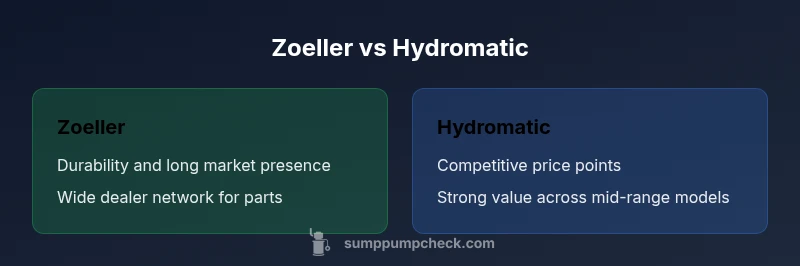
Zoeller has cultivated a reputation for durability and broad dealer coverage, making parts and service relatively easy to source in many regions. Hydromatic, by comparison, emphasizes value with models designed to minimize upfront costs while still delivering reliable performance for standard residential applications. The practical takeaway for homeowners is to weigh not just the sticker price, but the long-term costs tied to maintenance, spare parts, and availability of local technicians. The brand dynamics matter most when you live in an area with limited distributors or when you plan to expand your basement drainage system in the future. Understanding these positioning differences helps you align your choice with your local ecosystem and installation scenario.
Performance and Load Handling: What to Expect
Performance considerations for a zoeller vs hydromatic sump pump hinge on how well each unit handles common basement drainage tasks. Look beyond peak flow numbers and focus on reliability under continuous operation, auto-restart behavior after a power outage, and how the impeller design performs with sediment. Homeowners should expect both brands to perform adequately for typical basements, but the nuances matter: some models are better suited to higher head pressures or longer discharge runs. In practical terms, this means evaluating your sump pit size, the vertical distance to the discharge point, and the expected runoff volume during heavy rain events. A thoughtful comparison will map these household realities to model options within each brand family.
Build Quality and Materials: Durability that Lasts
Durability for sump pumps is closely tied to housing material and internal seal integrity. Zoeller models commonly feature robust cast-iron housings with proven sealing technology, designed to resist corrosion and long-term wear in damp basements. Hydromatic offerings often prioritize value-driven construction while maintaining reliable seals and bearings. The choice between materials matters most if your sump pit experiences frequent submersion, mineral buildup, or exposure to marginally acidic groundwater. In practice, durability translates into longer intervals between major servicing and a lower likelihood of premature impeller failure, which in turn reduces maintenance interruptions.
Maintenance and Serviceability: Keeping It Running
Maintenance needs for both brands revolve around regular inspection, seal and bearing checks, and the correct replacement parts when necessary. A key factor is the availability of gaskets, impellers, and check valves across local distributors. Zoeller's network often makes it easier to source common parts quickly, which supports faster DIY repairs or professional service. Hydromatic parts may require model-specific sourcing, but the parts ecosystem is generally strong for mainstream models. Homeowners should establish a simple maintenance schedule: monthly pit checks during heavy rainfall seasons, quarterly impeller and seal inspections, and annual test runs to verify auto-start functionality and cut-off operations.
Installation Considerations: Pit Sizing and Piping
Installation complexity is influenced by pit dimensions, discharge piping, and local code requirements. Zoeller pumps tend to have straightforward installation with commonly available 1-1/2 to 3/4 inch discharge fittings and compatible check valves. Hydromatic models, depending on the line, can be similarly straightforward, but some models may emphasize compact form factors or lighter components that affect how you seal the pit and route the discharge. The key is to ensure a proper seal at the discharge point, a correctly sized check valve to prevent backflow, and a vented, energy-efficient setup that minimizes air-bound issues and false pump triggers.
Warranty and Support Landscape: What It Really Means
Warranty depth and scope matter as much as the nominal price. Zoeller generally offers solid warranty terms on many models, with coverage that reflects the pump’s intended lifetime in normal residential use. Hydromatic warranties can vary by model and retailer, which means you’ll want to confirm the exact terms before purchase. Beyond the warranty, local support availability can influence total ownership costs. A strong dealer network translates to easier replacements for seals or impellers, faster service, and fewer delays when a part is needed after years of service.
Price and Value: Balancing Upfront Cost and Longevity
Price is a major consideration, yet it must be weighed against longevity, maintenance frequency, and replacement part availability. Hydromatic models often compete aggressively on upfront price, which can be appealing for budget-conscious projects or projects with tight initial budgets. Zoeller, while sometimes carrying a higher upfront price, can offer longer-term value through perceived durability, wider service networks, and more predictable long-term maintenance costs. In practical terms, homeowners should compare the same-pit configurations and model features across brands and then factor in the expected service costs over 5, 10, and 15 years.
Reliability and Reputation: What Endures in the Field
Brand reputation often reflects field performance across thousands of installations, not a single model. Zoeller's long-standing market presence contributes to a perception of reliability and a mature parts ecosystem. Hydromatic’s reputation tends to emphasize value and practical performance for everyday basements. Both brands perform well when paired with correct sizing, proper installation, and regular upkeep. Real-world reliability depends on model selection, adherence to installation guidelines, and timely parts replacement rather than brand label alone.
Common Failure Modes and Troubleshooting: Staying Ahead of Problems
Common issues include impeller wear, seal leaks, clogged intakes, and failed startup due to power or float switch malfunctions. Regular inspections help identify wear before failure. If the pump runs continuously, there may be a stuck float or blockage; if it won’t start, check the power supply, fuse, or circuit breaker, then inspect the switch and wiring. For both brands, maintaining a clean sump pit and a properly fitted check valve reduces backflow and unnecessary cycling. When troubleshooting, consult the model-specific manual for recommended spare parts and safe maintenance steps.
Real-World Scenarios: When to Choose Zoeller vs Hydromatic
If your priority is long-term durability and broad technician coverage, Zoeller is a strong choice, especially in areas with many local dealers and parts distributors. If upfront cost and immediate value are your primary drivers, Hydromatic models can offer compelling options, provided you verify warranty terms and parts availability for your region. For homes with challenging discharge routes or higher head pressure, a model that demonstrates robust cycling performance and reliable startup becomes critical, regardless of brand. In mixed environments, a balanced approach—matching a model from each brand to the intended application—can deliver the best overall outcome.
Maintenance Scheduling and Best Practices: How Often to Check
Create a simple calendar for sump pump care that aligns with local weather patterns and flood risk. Schedule a quick inspection monthly during wet seasons to ensure the float rises freely, the power supply is stable, and the discharge line remains clear. Conduct a more thorough quarterly check: verify seals, test auto-start/shutoff, and inspect the impeller for debris buildup. Annually, arrange a professional service to inspect electrical components, check the wiring, and confirm that the check valve functions correctly. Document maintenance activities to support future service and warranty claims.
Buying Checklist: Quick Reference Before Purchase
- Confirm model suitability for your pit size and discharge distance.
- Verify the warranty terms and what they cover.
- Check local availability of spare parts and service technicians.
- Compare the total cost of ownership, not just the sticker price.
- Review user reviews and local installation experiences to gauge real-world performance.
Comparison
| Feature | Zoeller | Hydromatic |
|---|---|---|
| Core design approach | Traditional, high-durability submersible design | Compact, cost-conscious design |
| Materials and housing | Cast iron housing with robust seals | Cast iron or aluminum variants depending on model |
| Warranty terms | Typically longer warranty on higher-end Zoeller models | Warranty terms vary by model and retailer |
| Parts availability | Broad dealer network and parts supply | Parts availability varies by model but generally available |
| Best for | Durability-focused homes and long-term ownership | Budget-conscious installations with solid baseline performance |
What's Good
- Strong dealer network supports parts and service
- Durable construction with proven reliability
- Solid long-term value for homeowners who prioritize longevity
- Clear maintenance expectations and standard serviceability
Drawbacks
- Model variations can create confusion over warranty terms
- Parts availability can vary by model and region
- Some entry-level Hydromatic models may include fewer premium features
Zoeller generally edges Hydromatic on durability and parts support; Hydromatic offers solid value for budget-minded buyers.
Overall, choose Zoeller for long-term reliability and extensive service networks. If upfront cost is the primary constraint and the model fits your needs, Hydromatic remains a viable alternative.
FAQ
What are the key differences between Zoeller and Hydromatic sump pumps?
Both brands deliver reliable submersible pumps, but Zoeller is often favored for durability and a broad parts network, while Hydromatic focuses on value in budget-friendly models. The best choice depends on your priorities and installation context.
Zoeller tends to emphasize durability and parts availability; Hydromatic offers budget-friendly options with solid basic performance.
Which brand tends to be more durable?
Durability varies by model and usage, not by brand alone. Review the specific warranty terms and service network for the exact model you’re considering.
Durability is model-specific; check the warranty and local service options for the model you choose.
Are parts easy to source for Zoeller and Hydromatic?
Both brands maintain distributor networks, but availability can be model- and region-dependent. Verify locally that common seals, impellers, and valves are readily stocked.
Parts are generally available, but it depends on model and location.
Does installation cost differ between brands?
Installation costs depend on pit size, discharge routing, and labor more than the brand itself. Some Hydromatic models may simplify installation, but it’s not guaranteed across all lines.
Brand choice rarely changes install cost; focus on pit and discharge specifics.
Which brand has better resale value?
Both brands hold value; Zoeller’s longstanding reputation can help resale, while Hydromatic’s value-oriented models appeal to budget buyers. Condition and maintenance matter as much as the label.
Zoeller’s reputation can help resale, but model condition matters most.
Top Takeaways
- Assess your priorities: durability, parts availability, warranty terms.
- Verify model-specific terms; warranties vary by model, not by brand alone.
- Consider total cost of ownership, including maintenance and parts.
- Check local availability of parts and technicians before buying.
- Choose model(s) that match your pit size and discharge distance.