Sump Pump Battery Backup vs Generator: A Practical Comparison
A data-driven comparison of sump pump battery backup vs generator, exploring reliability, cost, maintenance, safety, and best-use scenarios for homeowners and DIY enthusiasts.


According to Sump Pump Check analysis, for most homes, a sump pump battery backup offers fast response during short power outages and simple maintenance, while a generator handles long outages and high pumping loads. Battery backups are quieter, require less fuel, and install quickly; generators provide sustained power but need fuel, regular testing, and ventilation. The right choice depends on outage duration, climate, and budget.
Understanding the core question: sump pump battery backup vs generator
Selecting a reliable backup power solution for a sump pump is critical for basement protection. When homeowners compare the options, the core question becomes the sump pump battery backup vs generator. This choice shapes how quickly water is cleared, how long power can be sustained, and the total cost of ownership over the system's life. In practical terms, battery backup systems draw energy from a small battery and automatically kick in during a power outage, delivering immediate response. Generators, on the other hand, rely on fuel stores and an engine to run pumps for longer periods, often with a delay as the engine starts. According to Sump Pump Check, battery backups generally offer faster automatic responses during brief outages, while generators excel for multi-day events. To pick wisely, homeowners should map expected outage duration, climate risks (heavy storms or freeze-thaw cycles), and the structural demands of their sump pump. This framing helps homeowners recognize that the choice is not only about convenience but about resilience: the backup system should align with the most probable failure pattern and the home’s specific risk profile. By starting with this framework, you can evaluate product specs, maintenance requirements, and installation implications more clearly.
How a battery backup system works in practice
Battery backup units sit behind the primary sump pump, connected to an automatic transfer switch that detects power loss and switches the pump to battery power within seconds. Most systems use a sealed lead-acid or lithium-ion battery, with a built-in charger that reconditions the battery when grid power returns. When the water table rises or float switches trigger, the backup power kicks in, lifting water out of the pit. Modern setups integrate a low-voltage alarm to alert homeowners if the battery is low or needs replacement. One advantage of battery backups is their self-contained operation: you rarely need to handle fuel, and there is minimal noise beyond the pump itself. However, capacity is finite; the runtime depends on the pump’s demand and the battery’s state of charge. For a typical residential sump pump, a single battery can support a few hours of pumping during a brief outage; larger banks can stretch this to half a day or more. Keep in mind that extreme weather and repeated outages can drain the battery quickly, so planning for recharge and replacement is essential.
How a generator backup works and when it's used
Standby generators are installed outside the home and connected to automatic transfer switches. They run on propane, natural gas, or gasoline/diesel depending on model. Automatic start within a few seconds to a few minutes after sensing a power outage, and they provide longer runtimes because they draw fuel from a tank or supply line. Generators are painless for extended outages but have drawbacks: they require fuel, they produce noise, and there are CO risks requiring proper exhaust and detectors. For sump pumps, installation must ensure correct sizing to meet the pump’s demand; you should also consider weatherproofing and venting. Standby generators are more expensive upfront, but their big advantage is continued high-output performance for days. Portable generators yield flexibility but often require manual operation and safe fuel handling. A careful assessment of your climate and risk of multi-day power loss helps decide whether a generator is your best option, or if it should be paired with battery backup.
Key differences: reliability, maintenance, and cost over time
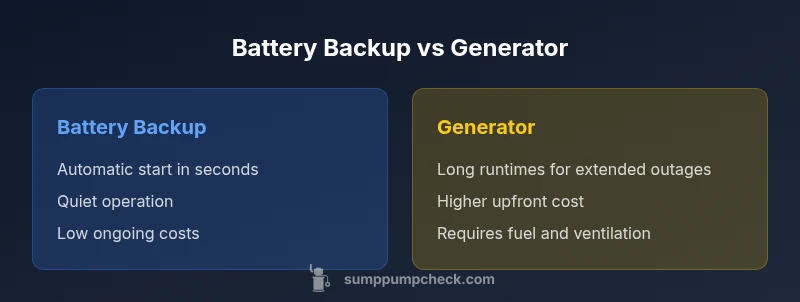
Reliability hinges on outage duration and load. Battery backups win for short outages and rapid response, with minimal ongoing maintenance. Generators win for extended outages and high pumping demands, with the caveat of more complex maintenance and fuel logistics. Maintenance burden follows a similar pattern: batteries require periodic SOC checks and replacements, while generators require regular oil changes, fuel stabilization, and annual service. Cost over time reflects usage patterns: batteries typically have lower upfront cost and quieter operation but may incur replacement costs every several years; generators incur higher upfront costs and ongoing fuel expenses, plus maintenance. For most single-pump basements facing common storms, a battery backup provides solid protection; for homes facing long blackouts or frequent large inflows, a generator offers greater resilience. A hybrid approach can balance both strengths, increasing reliability without depending on a single technology.
Sizing and installation considerations for each option
Sizing a backup system requires understanding the sump pump’s flow rate, head pressure, and the typical inflow during storms. For battery backups, you want enough capacity to cover the expected outage length, factoring in the pump’s horsepower and any other electrical loads connected to the system. For generators, sizing means matching the pump’s electrical load to the generator’s continuous-output rating plus a safety margin. Installation considerations include electrical code compliance, the need for a dedicated transfer switch, venting for generators, and weatherproof housing. Battery backups often require minimal space and can be installed indoors or in a utility area; generators require outdoor placement with proper clearance and exhaust routing. Always plan for maintenance access and routine testing to ensure readiness, especially before storm season.
Weather and climate impact on backup performance
Climate can dramatically influence performance. Cold temperatures reduce battery efficiency and overall run time, while heat can degrade batteries more quickly if poorly ventilated. Generators can suffer from fuel gelling in cold weather and require protective housing to resist snow and ice. High humidity can affect electrical connections and corrosion risk in outdoor installations. Conversely, mild climates with moderate storm frequency reduce stress on backup systems and simplify maintenance. When evaluating your options, consider how your local weather patterns interact with battery longevity, fuel availability, and the need for protective enclosures. A resilient plan accounts for both climate risk and the typical duration of outages in your area.
Outage scenarios: typical home cases and recommendations
In a single-day storm with brief outages, a battery backup configuration often provides adequate protection with minimal disruption. If outages are likely to last several days or you have large pumping needs (homes with high water tables or flood-prone basements), a generator becomes more compelling, especially if you anticipate repeated events over a season. For many households, a hybrid approach offers the best of both worlds: a battery backup handles quick, automatic responses, while a standby generator covers extended outages. In regions with severe weather or frequent flooding, consider augmenting with a water-sensing sump pump or an additional backup pump to further reduce risk. The key is to align the backup strategy with your risk profile and budget while ensuring proper installation and safety measures.
Cost overview: upfront vs operating costs and maintenance
Costs vary widely based on system size, local labor rates, and installation specifics. A compact battery backup kit with a small-inverter setup tends to have a lower upfront price and simpler wiring, while a large bank of batteries and a high-capacity transfer switch increases both cost and installation complexity. Standby generators generally incur higher upfront costs for the generator unit, weatherproof enclosure, and installation, plus ongoing fuel and maintenance expenses. For long-term budgeting, consider fuel costs, battery replacement cycles, and maintenance plans. A practical approach is to estimate total cost of ownership over 5–10 years and compare that to your risk tolerance and expected outage duration.
Safety, codes, and best practices
Sump pump backup installations must adhere to local electrical codes and safety standards. Install a dedicated circuit for the pump, use a properly rated transfer switch, and verify that outdoor generator installations include CO detectors, proper exhaust routing, and secure anchoring. Fire safety and ventilation are critical when running a generator in enclosed or semi-enclosed spaces. For battery backups, ensure proper ventilation for any lithium-based packs and utilize high-quality, sealed batteries with temperature controls. Regular test runs of both systems are essential to verify readiness, especially before hurricane or snow seasons. Always consult a licensed electrician or your local building department to ensure compliance with codes and safety requirements.
Hybrid approaches: combining backup battery and generator
A hybrid backup strategy combines the quick-response advantage of a battery backup with the extended-run capability of a generator. A hybrid system often includes an automatic transfer switch that prioritizes battery power during a brief outage and automatically starts the generator if outages persist beyond a defined window. This approach minimizes fuel use while ensuring water continues to be removed during multi-day events. It also allows maintenance planning to occur more flexibly, reducing the risk of total downtime. When designed correctly, a hybrid system provides continuous protection with less downtime and greater resilience in the face of storms.
Feature Comparison
| Feature | Battery backup | Generator | Hybrid system |
|---|---|---|---|
| Power duration | Depends on battery capacity; typically hours to a day for a single unit | Hours to days depending on fuel and tank size | Can combine battery runtime with generator run time to extend coverage |
| Startup speed | Automatic within seconds of outage | Automatic or manual start within seconds to minutes | Automatic transfer prioritizes battery; generator kicks in as needed |
| Fuel source | Stored electrical energy from batteries | Propane, natural gas, or diesel/gasoline | Combination of electricity and fuel (dual source) |
| Installation complexity | Low to moderate; compact footprint | Moderate to high; requires outdoor installation and exhaust considerations | Moderate; needs both components with integration |
| Noise level | Very quiet; pump noise dominates | Engine noise during operation | Moderate; depends on both components and enclosure |
| Maintenance burden | Low; battery SOC checks and eventual replacement | Regular servicing, oil changes, and fuel management | Managed maintenance with periodic checks of both systems |
| Best used for | Short outages, compact basements, and rapid response | Extended outages, high pumping needs, and severe weather | High resilience for long outages and peak demands |
What's Good
- Low upfront cost and quiet operation with battery backups
- Automatic activation and no fuel handling for battery backups
- Minimal ongoing maintenance compared to generators
- Flexible installation options for tight spaces
Drawbacks
- Limited runtime without recharging or battery replacement
- Battery degradation over time and replacement costs
- Generators require fuel storage, maintenance, and ventilation
Battery backup systems suit most homes as a primary defense; generators excel when outages last days or require high pumping capacity.
For typical storms, a battery backup provides quick response with lower maintenance. If outages may persist or pumping load is high, a generator offers extended resilience. A hybrid approach offers the strongest protection when budget allows.
FAQ
What is the main difference between sump pump battery backup and generator?
The main difference lies in duration and complexity: batteries provide quick, automatic relief for short outages with minimal maintenance, while generators sustain longer outages but require fuel handling and regular service. The choice depends on expected outage length and pumping demand.
Battery backups offer fast response for short outages; generators cover longer outages but need fuel and maintenance.
Can I run a sump pump on a generator and a battery backup at the same time?
Yes. A properly wired system can route power from a battery backup and a generator through an automatic transfer switch to ensure continuous operation during outages. This setup minimizes downtime but requires professional installation.
Yes, through an automatic transfer switch, you can run both with priority given to battery power during short outages.
Which is cheaper upfront, battery backup or generator?
Generally, battery backups have a lower upfront cost than standby generators, especially for basic configurations. Total cost also depends on pump size, desired run time, and installation complexity.
Battery backups usually cost less upfront than generators, but overall cost depends on capacity and installation.
How long can a sump pump run on a typical battery backup?
Runtime varies by battery size and pump demand. A modest backup might run a few hours, while larger battery banks can extend operation through shorter outages and, with planning, into longer events.
Runtime depends on battery size; expect hours for typical setups, longer with larger banks.
Are there safety concerns with generators?
Yes. Generators produce carbon monoxide and heat, require proper ventilation, and must be installed away from living spaces. Follow local codes and install CO detectors and weatherproof enclosures.
Yes. Ensure proper ventilation, CO detectors, and code-compliant, outdoor installation.
Do I need permits to install a sump pump backup system?
Permits depend on your location and the system type. Electrical work and outdoor generator installations commonly require permits and inspections. Consult your local building department.
Permits may be required; check with your local building department before installation.
Top Takeaways
- Assess your outage risk before choosing a backup system
- Battery backups offer quick response and low maintenance
- Generators provide sustained power for extended outages
- Hybrid systems maximize reliability in severe storms