Sump Pump and Battery Backup: A Comprehensive Comparison
Compare sump pumps with and without battery backup to understand reliability, installation, and maintenance. Learn how to choose, install, and care for backup systems during floods.


Choosing between a standard sump pump and a battery-backed system is a common DIY dilemma. This comparison highlights reliability, cost, and maintenance to help homeowners decide quickly. For most homes in flood-prone areas, a sump pump with a battery backup offers better protection when power is out, according to Sump Pump Check's analysis.
What is a sump pump and battery backup?
A sump pump is a submersible or pedestal pump installed in a sump pit to remove water that collects in basements or crawl spaces. When you add a battery backup, the system includes a secondary energy source that keeps the pump operating during power outages. In practical terms, this combination reduces the risk of basement flooding during storms when electricity may be unavailable. Brand context matters here: the Sump Pump Check team emphasizes that the most reliable setups integrate a primary pump with a rated battery backup to ensure continued operation when mains power fails. Homeowners should view this pairing as a proactive shield against unpredictable weather and aging electrical infrastructure. The goal is continuous water removal even when the grid goes down, protecting structural integrity and indoor air quality. Ready-made kits simplify installation, but compatibility with your sump pit, switch type, and discharge layout remains essential for success.
What is a sump pump and battery backup?
A sump pump is a submersible or pedestal pump installed in a sump pit to remove water that collects in basements or crawl spaces. When you add a battery backup, the system includes a secondary energy source that keeps the pump operating during power outages. In practical terms, this combination reduces the risk of basement flooding during storms when electricity may be unavailable. Brand context matters here: the Sump Pump Check team emphasizes that the most reliable setups integrate a primary pump with a rated battery backup to ensure continued operation when mains power fails. Homeowners should view this pairing as a proactive shield against unpredictable weather and aging electrical infrastructure. The goal is continuous water removal even when the grid goes down, protecting structural integrity and indoor air quality. Ready-made kits simplify installation, but compatibility with your sump pit, switch type, and discharge layout remains essential for success.
Comparison
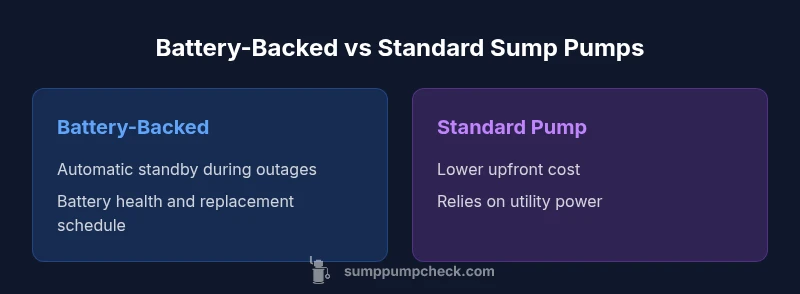
| Feature | Battery-backed sump pump system | Standard sump pump |
|---|---|---|
| Reliability during power outages | High protection with autonomous battery supply | Dependent on utility power; no fallback energy source |
| Maintenance needs | Regular battery checks, occasional replacement, and pump servicing | Minimal maintenance beyond basic pump care |
| Initial cost | Moderate up-front investment including backup battery kit | Lower initial cost for a single pump without backup |
| Lifespan & durability | Battery life adds a useful window for reliability; overall lifespan depends on battery type | Pump lifespan depends on quality and usage; no battery component |
| Beeping/alarm behavior | Battery backup systems often alert when battery needs replacement or maintenance | Standard pumps may have alerts but lack backup diagnostics |
| Best for | Homes in flood-prone areas with unreliable power grids | Homes with reliable power or minimal flood risk |
What's Good
- Significantly improves flood protection during outages
- Keeps basement dry when storms cut power
- Adds value by increasing system resilience
- Can be upgraded with modern battery technologies
Drawbacks
- Requires regular battery maintenance and replacement
- Higher upfront and ongoing costs
- More complex installation and potential professional help
- Battery performance can degrade in extreme temperatures
Battery-backed systems generally outperform standard pumps in power outages; choose backup if power reliability and flood risk are concerns.
For homes in outage-prone areas or with older electrical service, a battery backup is a smart investment. If the area rarely experiences outages and flood risk is low, a standard pump may suffice, but be aware of the trade-off in outage scenarios.
FAQ
What is a sump pump with battery backup, and how does it work?
A sump pump with battery backup combines a primary pump with a secondary power source (a battery) that engages during power outages. The battery provides enough runtime to keep water from accumulating in the pit, allowing the pump to operate until mains power returns or the battery is exhausted. Regular checks ensure the system starts automatically when needed.
A sump pump with battery backup uses a backup battery to run the pump when power is out, keeping water from pooling in your basement. It starts automatically and should be tested regularly.
Do I need a battery backup if I have a generator?
A generator can serve as an alternative power source, but it requires fuel, setup, and manual operation. A battery backup offers automatic operation during outages without human intervention. For most homes, a combined approach provides best-in-class protection.
A generator is a manual backup option; a battery backup runs automatically. Many homes benefit from both for continuous protection.
How long can a battery backup run a sump pump?
Runtime depends on battery capacity and pump demand. In typical scenarios, a well-sized battery backup may run through several hours during an outage, potentially longer with a smaller pump. Regular testing helps you know your system's specific endurance.
Runtime varies a lot; with a properly sized battery, you can expect several hours of operation during an outage, longer with a smaller pump.
What maintenance is required for a sump pump and battery backup?
Annual pump checks, battery voltage testing, and battery replacement every few years are common. Keep the discharge line clear, confirm the float switch moves freely, and test both the primary pump and backup during maintenance cycles.
Check the pump and battery yearly, test the backup, and replace batteries as needed. Make sure the discharge line stays clear.
Can I install a battery backup myself, or should I hire a pro?
Basic installations can be doable for handy homeowners, but wiring, float-switch alignment, and code compliance often benefit from a professional. A pro helps ensure compatibility with your sump pit, discharge routing, and electrical panel requirements.
You can do simple installs, but for safety and code compliance, a pro is usually the better choice.
Are beeping alarms common, and what do they indicate?
Beeping typically signals maintenance needs, such as a battery needing replacement or a sensor fault. Check the user manual for the exact alarm codes and perform the recommended actions promptly.
Beeps usually mean maintenance is needed or a fault detection occurred; follow the manual to resolve it.
Top Takeaways
- Assess your power reliability and flood risk before choosing.
- Opt for a battery backup with replaceable cells and clear indicators.
- Schedule regular battery checks and pump tests to ensure readiness.
- Estimate total cost of ownership, including battery replacements.
- Consider professional installation for critical basements and code compliance.