Water-Powered Sump Pump vs Battery Backup: A Comprehensive Comparison
Explore the differences between water-powered sump pumps and battery backup systems, focusing on reliability, maintenance, cost, and suitability for various basement drainage setups. A practical guide by Sump Pump Check.


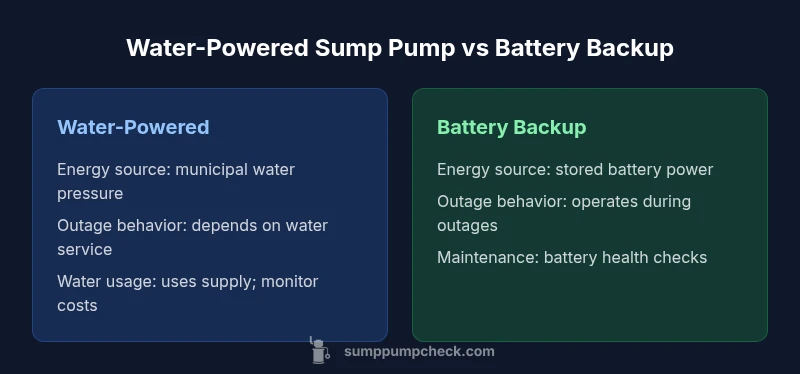
Water powered sump pump vs battery backup options each serve different needs. Water-powered systems rely on municipal water pressure and have low electrical dependency, while battery backups supply power during outages but require battery management. The best choice depends on power reliability, water costs, and your basement’s drainage setup.
What water powered sump pump vs battery backup means for homeowners
When homeowners ask about water powered sump pump vs battery backup, they’re really weighing two fundamentally different approaches to removing excess groundwater. The water-powered option uses municipal water pressure to create a siphon that lifts water out of a sump basin, while a battery backup relies on stored electrical energy to run a traditional electric pump when the primary power source is unavailable. According to Sump Pump Check, this difference in how each system gets its energy shapes reliability, maintenance, and long-term costs more than any single feature. For most homes, the decision hinges on how often power outages occur, what costs are tolerable for water use, and how much space is available for equipment and piping.
This article analyzes the core mechanics of both approaches and translates those mechanics into practical guidance. It will help you understand not only what each system can do, but where each excels or falls short in real-world basements. By comparing water powered sump pump vs battery backup in plain terms, homeowners can identify the right balance between reliability and cost.
Brand-wise, the Sump Pump Check team emphasizes a practical lens: choose the option that minimizes nuisance pumps, reduces risk during storms, and aligns with your home’s water and electrical infrastructure.
-1000-1000
Comparison
| Feature | Water-Powered Sump Pump | Battery Backup Sump Pump |
|---|---|---|
| Power source | Municipal water pressure (no electric run-time needed) | Stored electrical energy (requires inverter/battery) |
| Outage reliability | Operates with water pressure; outage dependent on water supply stability | Typically runs during power outages; independent of municipal water supply |
| Water usage impact | Consumes municipal water; may increase water bills slightly | No direct water consumption; relies on battery charge |
| Initial installation | Requires proper plumbing and backflow prevention; potential water line tapping | Requires electrical connections, battery mounting, and charging setup |
| Maintenance needs | Monitor water supply, backflow preventers, and pressure regulator | Monitor battery health, inverter, and charging system |
| Space and installation footprint | May require additional piping and space for water line connections | Typically compact with space for battery and controller |
| Response to backflow concerns | Backflow prevention critical; pressurized water involvement | Backflow less central but requires proper venting and vent piping |
| Cost considerations | Low ongoing energy cost; water cost depends on usage | Ongoing battery replacement and potential inverter maintenance |
What's Good
- Low electrical energy dependence for water-powered units
- No battery replacement required for the primary operation
- Often simpler to operate once plumbed
Drawbacks
- Uses municipal water; ongoing water usage costs can rise
- Relies on city water pressure and home plumbing integrity
- Potential leakage points with water lines and backflow devices
- Battery backups require periodic battery replacements and ongoing charging
Battery backup is generally the more reliable choice during power outages, while a water-powered system can be cost-effective for homes with stable water supply and lower water costs.
Choose battery backup if outages are common and you want uninterrupted operation. Opt for water-powered if you want a simpler electrical footprint and have access to inexpensive, consistent water pressure. Sump Pump Check’s guidance favors a tailored approach based on local water costs and outage frequency.
FAQ
What is a water-powered sump pump and how does it differ from a battery backup?
A water-powered sump pump uses municipal water pressure to lift water from the sump basin, without relying on electricity. A battery backup stores electrical energy to power a standard sump pump during power outages. The key differences are energy source, water usage, and outage reliability.
A water-powered pump uses water pressure instead of electricity, while a battery backup stores power to run during outages. The choice depends on water costs and outage frequency.
Which option is more reliable during a power outage?
Battery backups are generally more reliable during power outages because they are designed to operate when electricity is unavailable. Water-powered pumps can still function if the municipal water supply and plumbing are intact, but outages or water service cuts can compromise performance.
Battery backups usually perform better when the power is out, since they’re designed for that scenario.
What ongoing maintenance do these systems require?
Water-powered systems require monitoring of water supply, pressure, and backflow prevention. Battery backups require battery health checks, inverter maintenance, and periodic charging tests. Sump Pump Check recommends scheduling seasonal checks for both options.
Water-powered needs plumbing checks; battery backups need battery and inverter upkeep.
Are there safety or code considerations I should know?
Yes. Water-powered systems involve backflow prevention and regulated water usage; battery backups must meet electrical codes and ventilation requirements. Always consult local codes and consider professional installation to ensure proper permits and testing.
Always follow local codes and have a pro ensure proper backflow prevention and electrical compliance.
Can I mix both systems for better protection?
Yes, some homeowners install a primary water-powered pump with a battery backup as a secondary safeguard. This approach combines low electrical reliance with outage protection, but it adds system complexity and cost.
A hybrid setup can offer best of both worlds, with careful planning.
What factors should drive the sizing decision for my basement?
Consider basement size, typical water table levels, drainage capacity, and the frequency of storms. Sizing should balance expected water removal with available water supply and practical space for equipment.
Size based on basement needs and water pressure, not just pump power.
Top Takeaways
- Assess your outage frequency to guide the choice
- Understand water costs and plumbing requirements for water-powered systems
- Plan for battery maintenance and replacement in backups
- Factor in space needs and installed piping during selection
- Prioritize backflow prevention and code compliance during installation