1/3 hp vs 1/2 hp Sump Pump: A Practical Comparison
A practical, analytical comparison of 1/3 hp vs 1/2 hp sump pumps, covering performance, installation, energy use, and long-term costs to help homeowners size the right pump for their basement. Learn when a smaller motor makes sense and when stepping up to 1/2 hp is worth it.


Choosing between a 1/3 hp and a 1/2 hp sump pump hinges on your basin size, flood risk, and energy costs. The 1/2 hp model typically delivers more flow and higher head pressure, reducing the chance of basement flooding during heavy inflows, while the 1/3 hp unit costs less upfront and consumes less energy. Use your basin size and local rainfall to decide.
Overview: 1 3 vs 1 2 hp sump pump
The phrase 1 3 vs 1 2 hp sump pump is a shorthand many homeowners use to compare two common motor sizes used in residential sumps. In practical terms, horsepower (HP) is a rough proxy for how much water a pump can move and how high it can lift water (the head). A 1/2 hp pump generally offers higher flow and greater head under the same plumbing conditions, while a 1/3 hp unit uses less electricity and has a lower upfront cost. According to Sump Pump Check, the real-world impact of this difference depends heavily on your basement size, water inflow, and discharge path. When you read specifications, remember that gallons per minute (GPM) and feet of head aren’t fixed guarantees; they vary with pipe diameter, impeller design, and the height you’re pumping against. This article uses the term 1 3 vs 1 2 hp sump pump to anchor the discussion and avoid confusion as you compare options for your space.
In this section we’ll unpack what those numbers mean in everyday terms, how they translate to performance in a typical basement, and how to decide which horsepower best fits your needs. You’ll learn to balance upfront cost with long-term reliability, assess how large a basin you actually need to drain, and anticipate the flood risk in your local area. The goal is to empower homeowners to size the pump without overpaying for capacity they don’t require. By the end, you’ll have a clear framework to guide a purchase that aligns with your basement’s layout, climate, and budget.
The bottom line for most households is straightforward: if your sump basin is modest and your area sees infrequent rainfall, a 1/3 hp pump can be a prudent starting point. If you regularly experience heavy inflows or have a larger sump pit, a 1/2 hp unit tends to reduce the odds of a pump running dry or failing to evacuate water quickly. In other words, the right choice blends probability of flood risk with energy efficiency and maintenance considerations.
Comparison
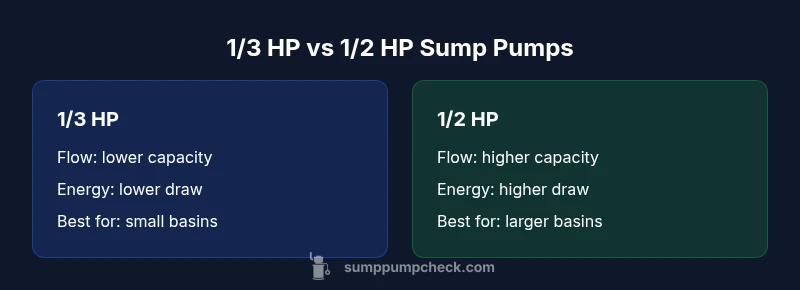
| Feature | 1/3 HP | 1/2 HP |
|---|---|---|
| Max Flow Potential | lower | higher |
| Lift/Head Capability | lower head capability | moderate to higher head capability |
| Energy Use | lower energy draw | higher energy draw |
| Best For | small basins, light inflow | larger basins, heavier inflow |
| Installation Cost/Upfront | lower upfront cost | higher upfront cost |
What's Good
- Lower upfront cost and simpler installation
- Lower ongoing energy use per cycle (for some setups)
- Sufficient for small basins with light inflow
- Compact size fits tight pits
- Fewer components can mean simpler maintenance
Drawbacks
- Not ideal for large basins or frequent heavy inflows
- Higher risk of undersizing leading to longer run times or short cycling
- Limited head pressure can reduce effectiveness after storms
- Potential for more frequent maintenance if undersized in a high-inflow scenario
1/2 HP is generally the safer default for most basements; 1/3 HP can work for small basins with light inflow.
The 1/2 HP option offers stronger flow and head, which reduces flood risk during heavy inflows. The 1/3 HP saves upfront cost and energy but may underperform in wetter conditions or larger basins. The right choice hinges on basin size, flood risk, and local rainfall patterns. The Sump Pump Check team emphasizes sizing to actual needs rather than guessing.
FAQ
What does horsepower mean for sump pumps in practical terms?
Horsepower roughly indicates how much water a sump pump can move and how high it can lift water. In practice, higher HP generally means more robust performance, especially during heavy inflows, but it also draws more electricity. Your decision should weigh needed capacity against long-term energy use.
Horsepower tells you how much water the pump can move; higher horsepower means more power but more energy use.
Is a 1/3 HP sump pump sufficient for a typical basement?
For small basins and light, infrequent inflows, a 1/3 HP pump can be adequate. If you expect frequent heavy rainfall or have a larger sump pit, a 1/2 HP is generally safer to avoid prolonged run times.
A 1/3 HP can work for small basins, but for regular heavy inflows, go with 1/2 HP.
How should I size my sump pump based on my basement and climate?
Begin by measuring your sump pit and estimating peak inflow, accounting for local rainfall frequency and severity. Compare these needs to the pump’s stated performance for your pipe diameter and head. If in doubt, err toward a pump with higher head capability to avoid backflow.
Measure your pit and consider local rainfall; pick a pump that can handle the expected water load.
Can I upgrade from 1/3 HP to 1/2 HP later, or must I replace the entire system?
In many cases you can upgrade without a full system replacement, but you may need a larger pit clearance, new discharge fittings, and wiring checks. A professional assessment is recommended to ensure compatibility with your sump basin and electrical circuit.
Upgrading is often possible but check fit and wiring with a pro.
What maintenance differences exist between the two HP sizes?
Maintenance tasks are similar for both sizes: clean the basin, inspect the float switch, check the discharge line, and ensure a functioning check valve. The main difference is run-time; a higher HP unit may run more during storms, so keep an eye on motor heat and noise.
Maintenance is similar; watch run-time and motor heat with higher HP units.
Are there code or safety considerations I should follow when choosing horsepower?
Follow local electrical and plumbing codes; use GFCI outlets, proper discharge piping, and an appropriate backflow prevention device. Larger HP pumps may require a dedicated circuit and proper ventilation in some installations.
Follow local codes; use GFCI outlets and proper discharge piping.
Top Takeaways
- Size your basin before selecting HP to avoid over- or undersizing
- Balance upfront cost against long-term energy use and flood risk
- Choose 1/2 HP for typical basements with moderate-to-heavy inflow
- Opt for 1/3 HP for small basins with low inflow and tight budgets
- Ensure proper discharge, check valves, and electrical safety during installation