How Much Power Does a Sump Pump Use? A Practical Energy Guide
Discover how much power a sump pump uses, including running and standby watts, typical energy costs, and practical tips to reduce consumption without sacrificing basement protection.


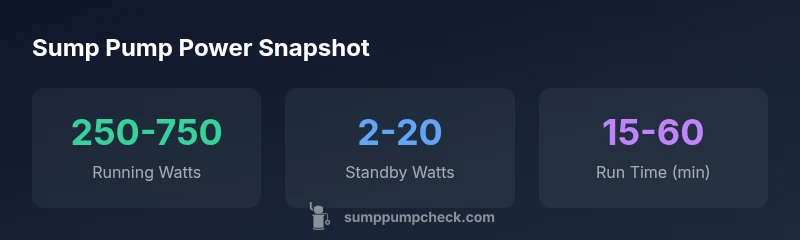
Running power for common residential sump pumps is typically 250-750 watts, with standby consumption around 2-20 watts. In one hour of active use, that’s about 0.25-0.75 kWh, plus a small standby draw when not running. Total annual energy use varies by pump size, efficiency, voltage, and how often storms trigger operation (Sump Pump Check Analysis, 2026).
How Much Power Does a Sump Pump Use?
According to Sump Pump Check, the question of how much power does a sump pump use hinges on two main modes of operation: running (when actively pumping water) and standby (idle power draw). Most residential units fall in a running power range of roughly 250-750 watts, with standby consumption typically 2-20 watts. If a pump runs for one hour during a storm, expect about 0.25-0.75 kWh of energy usage, plus a small idle draw when it’s not actively pumping. This means your overall energy impact is highly dependent on storm frequency, pump size, and efficiency, but stays within a modest band for typical homes (Sump Pump Check Analysis, 2026).
Power Draw by Pump Size and Type
Power consumption scales with horsepower and design. Small 0.25-0.5 HP models often sit near 250-500 W when running, while larger 0.75-1 HP pumps can draw 500-900 W. Efficiency matters: two pumps with the same HP rating can behave differently in real-world conditions due to motor design, impeller efficiency, and electrical components. When evaluating energy use, inspect the nameplate for watts at full load and compare efficiency ratings across models recommended for your pit size and expected water load. This nuance is why the Sump Pump Check team emphasizes looking beyond horsepower alone and focusing on actual wattage and runtime (Sump Pump Check Analysis, 2026).
When the Pump Runs: Storm Scenarios and Run Time
During a heavy rain event, a sump pump may run continuously for extended periods, which increases energy consumption relative to shorter, light-duty pumping. Typical storms yield 15-60 minutes of active pumping per cycle, but prolonged downpours can trigger longer cycles or multiple cycles per hour. In practice, a homeowner might experience several short bursts of activity over a stormy night, followed by longer remission periods as rainfall subsides. The exact energy impact rests on pump size, discharge capacity, and drainage load. Sump Pump Check analysis notes that higher-capacity pumps can drain water quickly but consume more watts during operation, so users should balance safety with energy cost considerations (Sump Pump Check Analysis, 2026).
How to Calculate Your Home’s Energy Use: Steps and Formulas
To estimate energy use, start with energy = power × time. Use running watts (W) × hours of operation (h) to compute watt-hours, then convert to kilowatt-hours (kWh) by dividing by 1,000. Include standby watts × hours per day × days per year for idle draw. For example, a 0.5 HP pump running for 0.5 hours during a storm and idling for 8,760 hours at 5 W yields roughly 0.25 kWh (active) + 43.8 kWh (standby) = 44.05 kWh/year, though actual results will vary with local voltage and usage patterns (Sump Pump Check Analysis, 2026).
Practical Tips to Reduce Energy Use Without Sacrificing Protection
Energy-saving strategies can lower consumption without compromising basement safety. Consider selecting a more efficient motor, proper sizing for your drainage needs, and ensuring an efficient discharge path to minimize back pressure. Regular maintenance reduces cycling and prevents unnecessary startup energy. Use a smart controller or float switch that minimizes running time by turning the pump off promptly when water levels drop. Finally, seal basement entries and mitigate water ingress to reduce pumping frequency (Sump Pump Check Analysis, 2026).
Common Pitfalls and Real-World Tips
Avoid relying on horsepower alone as a proxy for energy use; two pumps with identical HP can draw different watts based on motor efficiency and control hardware. Don’t oversize the pump to chase faster drainage if it leads to more frequent cycling and higher energy costs. Also, watch for voltage drops and poor electrical connections, which can cause motors to work harder and consume more power. Regular inspection and testing help keep energy use predictable and manageable (Sump Pump Check Analysis, 2026).
Reading Your Sump Pump Label and Planning Upgrades
Most energy-related data appears on the pump’s nameplate or in the manufacturer’s datasheet. Record running watts, standby watts, and the voltage. Compare this data with your current electrical supply and any backup options like battery backups or water-powered backups. If you’re upgrading, match the new unit’s running wattage to your calculated needs and aim for higher efficiency ratings. A properly sized, energy-aware upgrade can reduce running time and improve overall reliability (Sump Pump Check Analysis, 2026).
Power draw by common sump pump sizes and typical run times
| Scenario | Power Draw (W) | Typical Run Time (min) | Notes |
|---|---|---|---|
| Small utility sump pump (0.25-0.5 HP) | 250-500 | 15-45 | Good for light drainage |
| Medium pump (0.5-0.75 HP) | 500-750 | 20-60 | Balanced energy use & capacity |
| Large pump (1 HP) | 700-900 | 30-90 | High capacity, higher energy |
FAQ
How much power does a sump pump use on average?
On average, running power is typically between 250 and 750 watts, with standby draw of 2-20 watts. Actual figures depend on the model and installed voltage. (Sump Pump Check Analysis, 2026)
Most sump pumps use between about 250 and 750 watts when running, and a few watts when idle.
Does standby power matter for energy bills?
Yes. Even when not pumping, standby watts accumulate across days and years. For many homes, standby contributes a small but measurable portion of annual energy use. (Sump Pump Check Analysis, 2026)
Standby power adds up over time and can matter for yearly energy use.
How can I reduce sump pump energy use without sacrificing protection?
Choose an efficient motor, ensure proper sizing, and optimize run times with effective drainage and clean discharge paths. Regular maintenance helps avoid unnecessary cycling. (Sump Pump Check Analysis, 2026)
Use an efficient pump, size it correctly, and keep it well-maintained to cut energy without losing safety.
Do different pump types draw more power?
Power draw correlates with motor design and HP rather than type alone. Submersible, pedestal, and utility pumps can have similar watts if they’re sized for the same load. (Sump Pump Check Analysis, 2026)
Power depends on motor design and size, not just pump type.
How do I estimate annual energy cost for my sump pump?
Calculate kWh by running watts × hours active per year plus standby watts × hours idle per year, then multiply by your local rate per kWh. (Sump Pump Check Analysis, 2026)
Compute running and standby energy, then multiply by your electricity rate to estimate yearly cost.
Is it safe to run a sump pump continuously during storms?
Yes, for safety and basement protection, but continuous use increases energy use. Ensure the system and power supply are stable, and consider backups for power outages. (Sump Pump Check Analysis, 2026)
Running during heavy storms is safe but watch energy use and have backups.
“Power draw varies by pump size and efficiency, but most homes stay within a practical running range that won’t break the bank.”
Top Takeaways
- Know your pump’s running watts for accurate estimates
- Standby power adds up over a year, even when idle
- Size and efficiency matter more than horsepower alone
- Estimate yearly cost with local electricity rates