What Size PVC Do You Use for a Sump Pump? A Practical Sizing Guide
Discover the correct PVC size for sump pump discharge, with practical size recommendations, adapters, and best practices to prevent clogs and ensure reliable basement drainage.


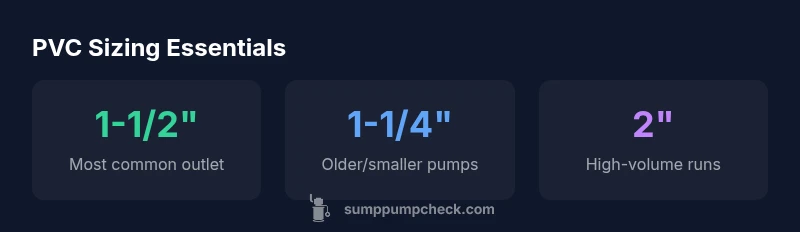
The standard PVC discharge for most sump pumps is 1-1/2 inch. Some smaller or older models use 1-1/4 inch, while higher-flow systems may use 2 inch. The key is to match the pump’s outlet to the PVC with a proper adapter, maintain a smooth slope, and avoid undersized piping that can cause clogs or strain the motor.
What size PVC do you use for a sump pump: core concepts
The core question many homeowners face is what size PVC do you use for a sump pump. The short answer is that the discharge size is driven by the pump’s outlet, the length and elevation of the run, and local code requirements. In practice, most residential sump pumps ship with a 1-1/2 inch discharge, which is large enough to avoid excessive friction in typical basements while fitting standard PVC stock. Some smaller or older pumps use 1-1/4 inch, particularly if the unit is compact or designed for light-duty service. High-volume or multi-pump configurations can demand a 2 inch line to prevent backpressure and maintain flow. The key is to verify the pump outlet size first and then select a PVC pipe that can be properly joined to it without creating restrictive bottlenecks. If you’re retrofitting or replacing a pipe, aim for smooth interior surfaces, compatible fittings, and a consistent slope that keeps water moving away from the foundation.
Discharge sizes in typical sump pump installations
Discharge size choices are not arbitrary; they reflect flow requirements, run length, and gravity considerations. A 1-1/2 inch PVC pipe is the default in most new installations because it provides a good balance of footage, fabrication ease, and affordable fittings. For older homes with existing 1-1/4 inch lines, you can typically adapt to a 1-1/2 inch system using a reducer or adapter, but you should confirm the pump outlet accepts the larger diameter. In scenarios where the discharge will travel through long runs, multiple bends, or two stories, a 2 inch line may reduce head loss and keep the pump from hitting its maximum flow. Regardless of diameter, ensure you use solvent weld joints or properly rated mechanical connections, and avoid oversized or undersized transitions that create stagnation or air pockets. Finally, check that the overall pathway exits above grade and vents are clear to prevent siphoning or backflow.
Matching pump outlets to PVC: adapters and fittings
Most sump pumps end in a particular threaded outlet, commonly 1-1/2 inch or 1-1/4 inch NPT. To connect to standard PVC, you’ll typically pair a solvent-weld PVC coupling or a union with a slip-fiber or threaded adapter. Keep the interior diameter as close as possible to the pump’s outlet. If you must step up from 1-1/4 to 1-1/2, use a gradual reducer; if stepping down, use a reducer in the opposite direction. Use clamps, check valves, and appropriate supports to reduce vibration and movement. Remember to avoid glue on areas you may need to disconnect for inspection; use unions where feasible. Finally, verify that the slope is about 1/4 inch per 10 feet to ensure gravity removal of water.
Pipe materials and their implications
PVC and CPVC are common choices for sump pump discharge lines in residential settings. PVC is inexpensive, easy to glue, and widely available in standard sizes. CPVC offers higher temperature tolerance but at a higher cost and with different solvent cement requirements. ABS is an alternative material in some regions, but mixing materials can create weak joints. Always use potable-water-safe cement that matches the pipe material and a compatible primer. When possible, choose schedule 40 PVC for a sturdy, pressure-rated system, and avoid thin-walled options if your run is long or uphill. Finally, plan for cleanouts or a short, accessible access point so you can clear blockages without significant disassembly.
Sizing tips for basement drainage scenarios
Consider the typical basement drainage layout when selecting PVC size. If your sump pump discharge exits straight to a storm drain or yard drainage, 1-1/2 inch is usually sufficient. If your run includes long horizontal sections, several elbows, or a depth change, a larger diameter like 2 inches helps reduce friction loss. For retrofits, measure the pump outlet diameter and buy an adapter that preserves as much interior cross-section as possible. Include a check valve to prevent backflow when the pump restarts, and secure the pipe with brackets to minimize movement during vibration. Finally, avoid depressingly long runs that dip below the floor level or high points where air can accumulate.
How to measure the right size on a retrofit
Begin by identifying the pump’s outlet size—most commonly 1-1/2 inch or 1-1/4 inch NPT. Visibly inspect the back of the pump for a label that shows the outlet diameter. If there is no label, measure the outside diameter of the outlet and match it to standard PVC adapters. Plan the route on paper first, listing all turns and vertical rises. Then purchase the PVC pipe in standard lengths (typically 10–20 feet) and use appropriate fittings to connect to the pump and to the discharge point. Finally, test the system with water to confirm there are no leaks and the flow does not whistle or surge.
Common mistakes and how to avoid them
- Selecting the largest possible pipe without considering pump outlet capability can waste material and increase installation effort. - Assuming all long runs require 2 inch pipe can cause over-engineering. - Skipping proper adapters or unions leads to difficult disassembly and leaks. - Forgetting to include a check valve increases backflow risk. - Ignoring slope and support can cause backflow, air locks, or vibrations.
When to upgrade or consult a pro
If your current discharge frequently clogs, leaks, or requires awkward fittings, or if you’re performing a major basement renovation, it’s wise to reassess pipe sizing with a pro. A professional can calculate friction loss based on run length, elevation, and pump curve, and help you choose the right PVC size, fittings, and support layout. For simple, single-pump installs in standard basements, home-improvement guides like this one often provide sufficient guidance to size correctly and maintain reliability.
Sump pump discharge sizing guide
| Scenario | Recommended PVC Size | Notes |
|---|---|---|
| Standard home sump pump | 1-1/2 inch | Most common size |
| Older pump / small unit | 1-1/4 inch | Check outlet size |
| High-volume pump / long run | 2 inch | Reduce head loss |
| Retrofit from metal or small pipe | 1-1/2 inch to 2 inch via adapter | Consider transitions |
FAQ
What size PVC should I use for a sump pump discharge?
Most residential sump pumps use a 1-1/2 inch discharge. Some older or smaller pumps use 1-1/4 inch, and certain high-volume setups may require 2 inches. Always verify your pump’s outlet size and choose a PVC size that matches or can be adapted without restricting flow.
Most sump pumps discharge through 1-1/2 inch PVC. Some older pumps use 1-1/4 inch, and high-volume setups may use 2 inches.
Can I mix pipe sizes in the discharge line?
Yes, with the proper adapters. Start with the pump outlet size, then step up or down gradually using reducers or adapters to maintain adequate internal diameter. Avoid abrupt changes that create turbulence or clogs.
Yes, use adapters to transition between sizes without abrupt changes.
Is 2 inch PVC ever required for sump pumps?
2 inch PVC is common for high-volume or long runs where friction losses would otherwise reduce flow. It’s not necessary for every home, but it’s a useful option when a standard 1-1/2 inch line shows signs of strain or backpressure.
2 inch may be needed for high-volume or long runs.
How do I know if my sizing is adequate?
Check for smooth water flow with minimal backpressure and no excessive vibration. Inspect for leaks at joints and verify that the discharge exits above grade with a proper slope. If you hear whistling or see backflow, sizing or fittings likely need adjustment.
Look for smooth flow, no leaks, and correct slope.
Do I need a check valve with PVC discharge?
A check valve prevents backflow when the pump stops and restarts, improving reliability. It’s especially important if the discharge line connects to other drainage that could siphon back toward the pump.
Yes, a check valve is usually a good idea.
What about retrofitting a sump line in a finished basement?
Plan carefully with access points and use unions where possible so you can inspect and service the line without destructive work. Use internal couplings that preserve as much cross-section as possible and avoid sharp bends that trap debris.
Plan routes with access points and use unions.
“Sizing the discharge correctly reduces clogs and backpressure, ensuring reliable water removal during heavy rainfall. Always match the pump outlet to the PVC with a proper adapter and maintain a clean slope.”
Top Takeaways
- Match PVC size to the pump outlet to avoid bottlenecks
- 1-1/2 inch is the default for most homes; larger only for specific needs
- Use proper adapters and unions for easy maintenance
- Plan for slope, supports, and check valves to prevent backflow
- Test the system after installation to confirm steady flow