Little Giant vs Campbell Hausfeld Sump Pumps: Side-by-Side Review
Objective comparison of Little Giant and Campbell Hausfeld sump pumps, covering performance, durability, installation, maintenance, and ideal use cases for homeowners.


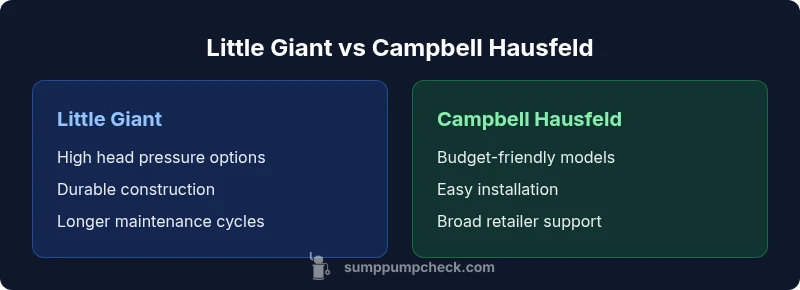
Across sump pump options, the Little Giant and Campbell Hausfeld brands each offer solid, budget-conscious choices. The best choice depends on your basement layout, discharge distance, and maintenance preferences. In general, Little Giant models tend to emphasize higher head pressure and durable construction, while Campbell Hausfeld options often prioritize affordability and ease of installation. Use objective criteria to compare flow, head, and reliability.
What matters in a sump pump comparison
When homeowners compare little giant vs campbell hausfeld sump pump options, the decision hinges on several practical factors. First, assess your pit size, discharge path, and the typical depth you need to lift water. Second, evaluate the pump's ability to maintain flow at varying head heights—how far and how fast water must travel from the pit to the discharge point. Third, consider the installation environment: cramped pits, wet basements, or remote outlets change what is feasible. Finally, factor in maintenance willingness and spare-parts availability. By anchoring your decision to these real-world constraints, you can select a model that delivers consistent performance without overpaying. For homeowners, the most reliable choice balances durable construction with straightforward maintenance and a serviceable parts network. This article uses the exact phrase little giant vs campbell hausfeld sump pump to emphasize the head-to-head nature of the comparison, while sticking to objective criteria you can verify in model specs.
Performance and head height
Performance for sump pumps is largely about the pump’s head height—the vertical distance water must be lifted—and the corresponding flow rate at that height. In the little giant vs campbell hausfeld sump pump comparison, Little Giant options are often positioned toward higher head pressure and robust cast-iron or composite housings that resist wear in demanding basements. Campbell Hausfeld models typically target mid-range head heights with affordability and quick availability in big-box retailers. Real-world results depend on model class, impeller design, and motor protection. Homeowners should examine the pump curve provided by manufacturers and compare it against their own discharge distance and elevation. A pump that can maintain steady flow at the required head height reduces the risk of nuisance alarms and incomplete basement drainage.
Build quality and materials
Durability is a core differentiator in the little giant vs campbell hausfeld sump pump comparison. Little Giant often uses more heavy-duty materials in the pump housing and impeller assemblies, aiming for longer service life in challenging basements. Campbell Hausfeld tends to emphasize practical durability with user-friendly designs and more accessible parts, which can be advantageous for DIY maintenance. The material choice matters for corrosion resistance, especially in humid or damp conditions where damp air and mineral buildup can affect performance over time. Look for pumps with sealed motors, corrosion-resistant housings, and robust float-switch configurations to minimize stalling and false alarms.
Installation and setup practicality
A major factor for DIY homeowners is how easy the unit is to install and service. In the little giant vs campbell hausfeld sump pump landscape, Campbell Hausfeld models are often praised for straightforward installation, standard outlets, and easier access to common spare parts. Little Giant offerings may require a bit more attention to mounting, check-valve compatibility, and conduit routing, but they reward users with long-term reliability and strong head pressure. Before buying, check that the model fits your pit dimensions, discharge pipe diameter, and available electrical outlets. If you’re upgrading from a cheaper single-stage pump, ensure you understand any required check valves, seals, or float-switch adjustments involved.
Maintenance and parts availability
Maintenance is a practical consideration that can sway the little giant vs campbell hausfeld sump pump decision. Campbell Hausfeld generally benefits from an extensive distribution network and easier access to replacement parts in many regions, which can lower downtime for DIY repairs. Little Giant’s maintenance ecosystem is robust as well, especially for higher-end models with longer warranties and more durable components. Regardless of brand, establish a routine: inspect the pump’s inlet screen, verify the float moves freely, test the auto-off switch, and check for unusual vibrations. Keeping consistent maintenance reduces the risk of clogs or motor burnout and helps you avoid emergency service calls.
Noise, vibration, and energy use
Residential pumps vary in noise and vibration depending on motor type, mounting, and the pump’s physical mass. In a head-to-head assessment, larger Little Giant units often generate slightly more audible vibration due to heavier housings, but solid mounting and a stable sump pit can mitigate this issue. Campbell Hausfeld models typically emphasize compact design and quieter operation for finished basements and living spaces. Energy efficiency correlates with motor load and run-time; choosing the right size helps minimize electricity use while maintaining reliable drainage during heavy rain events.
Warranty, support, and long-term value
Warranty terms and customer support shape long-term value in the little giant vs campbell hausfeld sump pump comparison. Higher-end Little Giant lines frequently offer longer warranties and more comprehensive parts coverage, reflecting a commitment to durability. Campbell Hausfeld tends to provide competitive warranties with broad retailer support, which can translate to easier replacement part access in many areas. When evaluating, compare warranty duration, what it covers (seal leaks, motor, impeller wear), and whether professional service is required for warranty claims. A strong support network reduces total ownership costs and downtime during repairs.
Sizing, pit compatibility, and installation context
Sizing is critical: a pump that’s too small may run continuously and fail to keep up with wet conditions, while an oversized pump can lead to short cycling and increased wear. The little giant vs campbell hausfeld sump pump decision should consider pit size, discharge diameter, and expected storm flow. For tight pits, Campbell Hausfeld’s more compact models may offer easier fit and lower installation friction. In larger pits with longer discharge runs, a Little Giant option with higher head height and robust motor protection can maintain flow more consistently. Always verify the model’s label for recommended pit dimensions and discharge specifications.
How to choose between the two brands: a practical decision guide
To decide between little giant and campbell hausfeld sump pump options, start with a practical checklist. 1) Measure discharge distance and vertical lift, 2) Inspect pit dimensions and outlet size, 3) Assess the required flow at peak storm pressure, 4) Check maintenance willingness and spare-part access, 5) Confirm compatibility with existing check valve and piping, 6) Evaluate warranty expectations and after-sale support. Be sure to compare multiple models within each brand to avoid basing the decision on a single feature. By following this framework, you can select a sump pump that meets your home’s drainage needs without overpaying or compromising reliability.
Comparison
| Feature | Little Giant | Campbell Hausfeld |
|---|---|---|
| Head height compatibility | High head pressure options with robust construction | Mid-range head height options with affordable pricing |
| Flow rate range | Strong flow performance at higher lift | Adequate flow for standard residential drains |
| Materials and durability | Heavy-duty housings, durable impellers | Solid build with emphasis on accessibility and parts availability |
| Installation ease | May require careful mounting and check-valve planning | Typically straightforward installation with common outlets |
| Maintenance and parts | Excellent long-term parts availability for premium models | Good parts availability and retailer support |
| Warranty and support | Longer warranties on higher-end lines, strong support | Competitive warranties with broad retailer coverage |
| Best for | Homeowners needing high head pressure and durability | Budget-conscious homes needing easy install and value |
What's Good
- Durable construction with long service life
- Higher head pressure options in Little Giant lineup
- Budget-friendly models from Campbell Hausfeld
- Broad availability and easy warranty claims
Drawbacks
- Higher upfront price on top Little Giant models
- Some Campbell Hausfeld models may have lower head performance
- Model-to-model variation requires careful spec comparison
Choose based on priorities: Little Giant for head pressure and durability; Campbell Hausfeld for budget-friendly, easy installation.
If you need stronger lifting capability, go Little Giant. If budget and quick setup matter most, Campbell Hausfeld is typically the smarter pick. Always verify model-specific specs and warranty details.
FAQ
What are the main differences between Little Giant and Campbell Hausfeld sump pumps?
The two brands balance durability and cost differently. Little Giant often emphasizes higher head pressure and robust construction, while Campbell Hausfeld focuses on affordability and straightforward installation. Evaluate model specs, not brand names alone.
Little Giant tends to offer higher head pressure and tougher builds, while Campbell Hausfeld usually provides budget-friendly, easy-to-install options. Compare specific model specs to see which fits your home better.
Are these pumps suitable for basement sump pits of all sizes?
Sump pumps come in various sizes to fit different pit dimensions. Check the manufacturer’s pit compatibility and the pump’s suction inlet size. For very large or very small pits, select a model that explicitly lists compatible pit dimensions.
Most pits have a compatible model, but always verify the inlet size and recommended pit dimensions before purchasing.
Can I install either brand myself, or should I hire a professional?
Many homeowners install sump pumps themselves, especially models from Campbell Hausfeld that emphasize straightforward setup. If your pit is irregular, you have multiple discharge runs, or you’re unsure about electrical connections, a professional installation is wise.
You can usually install it yourself if you’re comfortable with basic plumbing and electrical work; otherwise, a pro is a safer bet.
Do these pumps require a check valve or any special attachments?
Most sump pump installations benefit from a check valve to prevent backflow. Some models include integrated check-valve options, while others require separate components. Plan for piping fit and compatibility when comparing brands.
Yes, you’ll typically need a check valve with your discharge line, and some models may include one built-in.
Which brand has better warranty coverage for residential use?
Warranty terms vary by model, but both brands offer solid coverage for residential use. Higher-end Little Giant models often come with longer warranties, while Campbell Hausfeld provides competitive terms with broad retailer support. Review the exact model warranty before buying.
Warranty varies by model, but both brands offer solid residential terms; compare the specific model’s warranty length and coverage.
Top Takeaways
- Define your discharge distance and head height first
- Compare head pressure and flow ranges across models
- Evaluate installation ease and maintenance needs
- Consider total cost of ownership, not just upfront price
- Check warranty length and local support availability