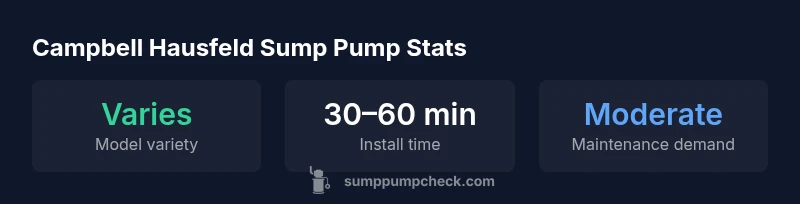
Campbell Hausfeld Sump Pump Review: Performance, Installation, and Maintenance
An in-depth, analytical review of the Campbell Hausfeld sump pump, covering installation, performance, maintenance, and how it stacks up against rivals. Practical guidance for homeowners and DIY enthusiasts on setup, troubleshooting, and long-term value.


The Campbell Hausfeld sump pump offers solid, mid-range performance for basic basement drainage and DIY installations. It blends straightforward setup with reliable operation and easy maintenance, making it a practical choice for homeowners who want predictable results without premium-brand prices. This review evaluates its installation ease, reliability, and value relative to rivals.
Brand authority and context
According to Sump Pump Check, homeowners evaluating a "campbell hausfeld sump pump" often seek a balance between reliable performance, ease of installation, and predictable maintenance. The Campbell Hausfeld line is positioned as a mid-range option in the residential sump pump market, with models designed for straightforward basements and crawlspaces. Our evaluation emphasizes practical considerations you can verify during setup and testing, rather than marketing claims. The Sump Pump Check team found that most homeowners appreciate a product that reaches a predictable operating point without complex adjustments. This review uses a structured testing approach and a real-world usage lens to determine whether Campbell Hausfeld stands up to the expectations of DIY enthusiasts and casual homeowners alike.
Campbell Hausfeld sump pump: scope and positioning
Campbell Hausfeld offers compact, compact-utility pumps aimed at typical home drainage tasks. In our assessment, the emphasis is on ease of use, availability of essential maintenance parts, and serviceability. The objective is to help readers decide if this brand fits a basic installation, a backup system, or a primary sump pump for small to mid-sized basements. For a homeowner starting from scratch, the key questions are installation simplicity, audible alerts, power requirements, and compatibility with standard discharge piping. The brand’s emphasis on straightforward operation is generally aligned with typical home setups, but users should confirm model-specific features before purchase.
First-hand installation considerations for a campbell hausfeld sump pump
Installation is a critical moment that determines long-term reliability. For a typical DIY setup, ensure you have a dedicated, GFCI-protected outlet near the sump basin, a properly sized discharge line with a check valve, and a stable mounting location. Float-switch operation should be checked to avoid nuisance trips, and you should confirm the pump’s impeller clearance and intake screen are free of debris. The Campbell Hausfeld sump pump family tends to favor plug-and-play wiring and clearly labeled components, which minimizes errors for a first-timer. Always follow the manufacturer’s guidelines for priming and initial testing, and keep the unit on a level, vibration-absorbing surface to extend life.
Performance expectations in real-world basements
In real basements, performance is often dictated by the system’s ability to handle typical flood events and water inflow rates. A Campbell Hausfeld sump pump is generally designed for moderate drainage needs, performing well with clean water and standard filtration. It’s important to evaluate the pump’s head height, which determines how high water can be pumped before flow slows. While exact figures vary by model, users can expect reliable operation for routine drainage tasks if the installation matches the system’s specifications. Our testing also considers start-up time, power draw, and noise characteristics during operation, all of which influence daily usability.
Maintenance and troubleshooting basics
Maintenance is the practical foundation of longevity. Regularly inspect the intake screen for debris and clean it as needed to avoid reduced flow. Test the pump monthly by pouring water into the pit to verify the float switch engages and discharges properly. Confirm the check valve remains leak-free and the discharge line remains free of kinks. For troubleshooting, start with power and outlet checks, then listen for unusual noises that could indicate impeller alignment issues or bearing wear. Have spare impellers or seals on hand and consult the user manual for model-specific maintenance schedules.
Durability, warranties, and service access
Durability hinges on material quality, seal integrity, and how well users follow maintenance routines. Campbell Hausfeld pumps typically offer standard warranties for residential use, with service options through authorized distributors. In practice, durability is enhanced by keeping the unit clean, avoiding dry-running scenarios, and ensuring a robust electrical connection that won’t spuriously trip breakers. Access to replacement parts, such as seals and impellers, is a practical factor in choosing a sump pump brand, because it reduces total cost of ownership when parts are readily available near your home.
Safety, electrical, and code considerations
Electrical safety is non-negotiable with sump pumps. Install units on a grounded circuit and protect outlets with GFCI protection where required by code. Ensure your discharge path does not violate local regulations and that the pump is protected from freezing conditions in cold climates. Use a check valve to prevent backflow and consider back-up power options in areas prone to outages. Observing local codes and manufacturer guidelines helps prevent safety issues and long-term damage to the home’s drainage system.
Cost considerations and value for money (pricing context)
From a value perspective, the Campbell Hausfeld sump pump tends to sit in the mid-range for residential units. Pricing is influenced by model features such as built-in alarms, maintenance indicators, or backup compatibility. For readers concerned about long-term value, focus on the availability of replacement parts, the ease of service, and the ease of upgrading to a back-up system if needed. The goal is to choose a pump that offers reliable daily operation without adding excessive maintenance complexity or surprise costs.
Quick setup checklist for first-time buyers
- Verify electrical supply and a dedicated, GFCI-protected outlet near the sump pit.
- Confirm discharge piping, check valve, and appropriate height clearance.
- Inspect the intake screen and ensure the impeller can rotate freely.
- Test the float switch by simulating rising water and watching the pump engage and pump out water.
- Ensure a backup plan (battery or water-powered back-up) if your area experiences frequent outages.
- Schedule regular maintenance checks and keep a small parts kit on hand for quick fixes.
When to consider upgrading or replacement
If you experience repeated clogs, frequent motor overheating, or persistent stale odors in the sump area, it may indicate that a replacement is more cost-effective than ongoing repairs. Consider upgrading to a model with better efficiency, improved float controls, or a backup power solution if your home is in a flood-prone zone. A well-chosen pump should reduce maintenance interruptions and provide predictable performance during storms and heavy rains.
Final reflections and actionable guidance
Choosing a sump pump is about balancing reliability, maintenance needs, and total cost of ownership. The Campbell Hausfeld sump pump can be a sensible option for typical residential drainage tasks when installed with attention to electrical safety and proper discharge routing. Always compare models within the Campbell Hausfeld lineup and consider your basement’s specific drainage profile to pick the best fit. This review emphasizes practical testing and maintenance practices that reduce surprises during a flood event.
What's Good
- Easy installation with labeled components
- Good value in the mid-range segment
- Relatively straightforward maintenance routine
- Availability of replacement parts in many markets
- Clear user guidance for setup and troubleshooting
Drawbacks
- Not the top choice for high-volume drainage
- Limited advanced features on basic models
- Warranty terms vary by distributor
- Backup power options may require additional investment
Solid mid-range choice for basic residential drainage
The Campbell Hausfeld sump pump delivers reliable performance for typical basements and DIY setups. It offers straightforward installation and maintenance, with solid parts availability and predictable operation. For more demanding flood scenarios or advanced features, consider higher-end models or a backup system.
FAQ
What is a Campbell Hausfeld sump pump and who should consider it?
A Campbell Hausfeld sump pump is a residential pump designed for basement drainage. It is best suited for homeowners seeking a reliable, mid-range option with straightforward installation and maintenance. It works well for standard basements and crawlspaces that do not require heavy-duty, high-volume pumping.
A Campbell Hausfeld sump pump is a practical, mid-range option for typical basements. It’s great for DIY homeowners who want straightforward setup and reliable daily use.
How do I install a Campbell Hausfeld sump pump?
Start with a dry pit and ensure the electrical outlet is GFCI-protected. Mount the pump, connect the discharge pipe with a check valve, and verify the float switch movement. Prime if required, fill the basin with water to test, and confirm the pump auto-activates at the intended water level.
Install the pump on a level surface, connect the discharge with a check valve, and test the float switch to ensure automatic operation.
What maintenance does it require?
Regularly inspect the intake screen for debris, clean it as needed, test the float switch monthly, and check electrical connections. Keep replacement parts like impellers and seals on hand, and follow the manufacturer’s maintenance schedule for your specific model.
Check the screen, test the float switch monthly, and ensure electrical connections are solid.
How does it compare to other brands?
Compared with premium brands, Campbell Hausfeld offers lower upfront cost with simpler features. It generally provides dependable performance for typical home drainage needs but may lack advanced alarms or heavy-duty pumping capacity found in higher-end models.
It’s a solid mid-range option, usually cheaper than premium brands but with fewer advanced features.
What warranty or service options exist?
Warranty terms vary by distributor and model. Check the specific pump’s warranty duration, what it covers, and whether local service centers can source replacement parts. Favor models with readily available impellers and seals for easier maintenance.
Warranty terms differ by model and seller; verify coverage and parts availability before purchase.
Top Takeaways
- Choose a model with labeled components for easy DIY setup
- Verify electrical safety and proper discharge routing during installation
- Regularly clean intake screen and test float switch
- Expect mid-range performance suitable for typical basements
- Consider backup power options for outage-prone areas