How Big of a Generator to Run a Sump Pump: Practical Sizing Guide
Learn how to size a generator to power a sump pump during outages, with a simple calculator, practical ranges, and safety tips.


How the sizing works: running watts and startup surge
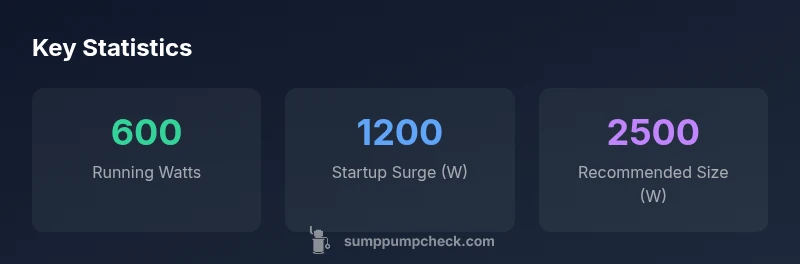
Sizing a generator for a sump pump begins with two numbers: running watts and startup surge. The running watts describe how much power the pump needs while running, while the startup surge is the brief spike when the motor begins to turn. For a typical 0.5 HP pump, running wattage often sits in the 350–500 watt range, but startup watts can climb to 800–1200 watts or more depending on the model. Because startup surges vary by brand and impeller design, you’ll want a safety margin well above the running wattage to ensure the motor starts reliably. According to Sump Pump Check, planning for both the continuous load and the startup spike is the key to avoid nuisance tripping or a stalled pump during a flood event.
- Running watts vs. surge: define what the pump needs to start and keep running.
- Typical ratios: consider startup requirements that can be 2–3x the running wattage for larger models.
- Margin strategy: add 20–50% cushion to absorb variations in efficiency and motor age.
This section sets the stage for choosing a generator size that keeps your basement dry without overpaying for unused capacity.
Key factors that influence generator sizing
When choosing the right generator, several factors influence the final number. First, confirm the sump pump’s horsepower rating from the label; 0.5 HP and 1 HP models have very different startup needs. Second, determine whether you will power only the pump or also light and basic household circuits during outages. Third, consider the environment: a cold, damp basement or long outages may justify a larger unit to handle extended operation and auxiliary devices. Fourth, check whether your pump is rated for continuous operation during extended outages, as some designs benefit from a dedicated transfer switch that isolates the pump from other loads. Finally, verify that you’re using a generator with proper overload protection and that the outlet style matches the pump’s plug configuration.
- Horsepower vs. watts: convert HP to watts (1 HP ≈ 746 W) for apples-to-apples sizing.
- Surges and duty cycle: pumps may require bursts shortly after startup.
- System margins: a larger margin reduces the risk of brownouts or stalls.
Using a sizing calculator: what the outputs mean
A dedicated calculator helps translate running watts, startup surge, and safety margins into a recommended generator size. Inputs typically include the sump pump running power, a startup surge multiplier, and any additional safety margin. The calculator multiplies the running wattage by the surge factor, adds the margin, and then accounts for any extra load you specify. The result is a wattage figure you should target when shopping for a generator. Remember, the calculator yields a sizing guideline, not a guarantee—always verify with the pump label and consider a conservative buffer for future upgrades.
- Understanding the inputs: what each field represents and why it matters.
- Interpreting the output: how to translate watts into a generator purchase.
- Real-world checks: double-check startup specs on your specific pump model.
Typical ranges for common sump pump setups
For many residential setups, the running wattage of a sump pump is relatively modest, but startup surge can be much higher. A small to mid-size pump (roughly 0.25–0.5 HP) may run comfortably on 500–900 watts and surge to 1000–1800 watts. Larger pumps (0.75–1 HP) often require 600–1000 watts running power with startup surges of 1500–2500 watts. Given these variations, a common practical range for backup power is 1000–4000 watts, with most homeowners selecting a portable generator in the 2000–3000 watt bracket to cover the pump and occasional extra loads. Always size conservatively and check the pump’s starting current before purchasing.
- Small pumps: 500–900 W running, 1000–1800 W surge.
- Medium pumps: 600–1000 W running, 1500–2500 W surge.
- Large pumps: 800–1200 W running, 2000–4000 W surge.
Sump Pump Check’s analysis shows that real-world requirements often skew toward the higher end when considering aging motors and colder operating conditions.
Safety considerations when powering a sump pump with a generator
Powering a sump pump with a generator demands strict safety practices. Do not run generators indoors, in garages, or in enclosed spaces—the exhaust contains deadly carbon monoxide. Install a transfer switch or interlock kit to isolate the pump from the house circuits and to prevent backfeeding into the utility lines. Use a properly grounded, weather-resistant outlet, and keep the generator outdoors on a dry, level surface away from doors and windows. Store fuel in approved containers, away from living spaces, and never refuel a hot engine. A CO detector is a must-have in any space connected to a backup power plan.
- Transfer switch is essential for safe, code-compliant operation.
- Outdoor placement and ventilation are non-negotiable for safety.
- Regular fueling and maintenance reduce the risk of unexpected outages during storms.
Maintenance and future-proofing your sump pump backup power
Plan for the long term by testing your backup power setup at least twice a year. Run the sump pump with the generator under load to verify that voltage and amperage remain stable during startup and operation. Consider a dedicated battery backup or an inverter-based generator if you expect frequent outages or need to power multiple devices. Periodically check the pump’s float switch and discharge line to ensure reliability in freezing or icy conditions. Keeping spare parts and a simple fuel plan helps you remain prepared for severe weather events.
- Regular load testing reveals real-world performance.
- Battery backups or multi-fuel generators offer flexibility.
- Inspect critical components (float switch, discharge pipe) before storm season.