Wayne vs Zoeller Sump Pump: Comprehensive Brand Comparison for Homeowners
A detailed, analytical comparison of Wayne vs Zoeller sump pumps, focusing on build quality, performance, maintenance, warranty, and value to help homeowners choose the right model for basement drainage.


Wayne vs Zoeller sump pump: for most basements, Zoeller tends to offer tougher build and longer warranties, while Wayne models are often more budget-friendly with broad availability. The best pick depends on your maintenance tolerance, budget, and local service options. See our deeper analysis for model-by-model nuances and decision criteria.
Wayne vs Zoeller sump pump: Context and scope
In the world of basement drainage, homeowners frequently encounter the choice between Wayne and Zoeller sump pumps. This is often framed as the core question in the decision process: the <strong>wayne vs zoeller sump pump</strong> dilemma. The Sump Pump Check team emphasizes that no single brand fits every basement scenario; instead, the decision should align with your basement’s size, water table, and your willingness to perform routine maintenance. From the outset, it’s important to recognize that Wayne and Zoeller are established brands with long product histories, offering models across price points, feature sets, and materials. The aim here is not to crown a winner, but to map where each brand tends to perform well, where tradeoffs appear, and how to interpret warranty terms. For homeowners, practical factors—installation constraints, service availability, and maintenance routines—often matter more than glossy marketing claims. This article provides actionable guidance, criteria for comparison, common failure points to watch, and a framework you can reuse when evaluating other brands. According to Sump Pump Check, grounding your decision in real-world needs and home specifics leads to better outcomes.
Key differences that matter in practice
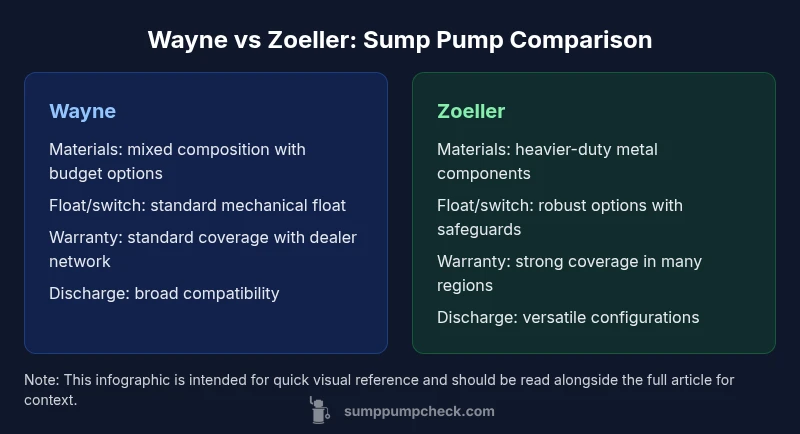
When comparing Wayne vs Zoeller sump pumps, readers should focus on these practical differentiators that influence daily use, long-term reliability, and cost over time. First, materials and construction quality can affect wake-up time during power outages and resistance to basement humidity. Zoeller models frequently emphasize heavier-duty metal components, while Wayne models may balance cost and performance with a broader mix of materials. Second, switch design and fail-safes influence reliability: some Zoeller units emphasize robust float switches and additional safeguards, whereas Wayne options may prioritize straightforward installations and ease of maintenance. Third, warranty terms and service networks shape how quickly you can obtain replacements or repairs, especially if you live in areas with limited local distributors. Fourth, installation flexibility matters: some basements require specific discharge configurations or pit dimensions, which can tilt the choice toward one brand over the other. Finally, maintenance burden varies by model; the brand with more durable components may reduce service calls over time, but a lower upfront cost can increase total cost of ownership if failures are more frequent. Sump Pump Check’s framework stresses evaluating these dimensions in context of your home rather than relying on broad brand reputations alone.
Build quality and materials
The construction quality of a sump pump affects its longevity and resistance to basement conditions. Zoeller is known for incorporating heavier-duty metal components and robust housings in many of its models, which can translate into greater long-term durability in damp environments. Wayne, historically focused on broader market access and lower upfront costs, often employs a mix of cast iron, premium plastics, and composite parts depending on the model tier. Homeowners should consider the trade-off between weight, heat dissipation, and corrosion resistance when choosing between brands. Heavier pumps can be tougher to lift during maintenance and installation but may resist corrosion in humid basements. Lighter builds can simplify installation but might demand more frequent inspection for wear. Regardless of brand, ensure your chosen model uses a metal volute or reinforced housing where possible and includes protective seals to minimize leakage. The compatibility of fittings, gaskets, and discharge connections also affects ease of service and future upgrades. In practice, a durable build reduces the risk of warping, cracking, or stagnation that leads to pump failure under heavy rain or high groundwater levels. The goal is to pick a model that remains reliable after years of seasonal cycling and occasional power outages.
Pump performance and head pressure
Performance is a core factor in any sump pump comparison. Wayne and Zoeller brands typically offer models that can handle a range of basement drainage demands, from small crawlspace pits to larger sump pits. When evaluating performance, homeowners should consider head height (the vertical lift required to push water to the discharge point) and anticipated flow rate under typical conditions. Zoeller models often emphasize more consistent flow and stronger performance in higher head scenarios, while Wayne models may prioritize a balanced approach that caters to standard basement setups with reasonable power and efficiency. It’s important to select a model whose performance aligns with your actual needs: a compact basement with modest water inflow may perform well with a mid-tier Wayne pump, whereas a larger, higher-volume basement might benefit from Zoeller’s robust options. In either case, verify that the model includes a thermal overload protection feature, which helps prevent motor burnout during prolonged pumping sessions. Expect performance to vary across series and model lines, so read spec sheets carefully and compare similar head heights and flow expectations side-by-side.
Float switch design and fail-safes
Float switch design is a critical reliability factor, especially in long-term maintenance and monitoring scenarios. Zoeller typically offers models with sturdy vertical switches and integrated fail-safes that minimize nuisance shutoffs or stuck float conditions. Wayne also provides reliable float mechanisms, but some lower-cost variants may rely on simpler switches that require more regular inspection to avoid false triggers. A robust sump pump should include a mechanical float or electronic sensor with redundancy options, such as dual float configurations or alert features for abnormal operation. When evaluating, check for features like automatic shutoff at dry-pit conditions, a failsafe that prevents sudden cycling, and clear indicators or alarms (where relevant) to notify homeowners of potential issues. For homeowners using basement sump basins with irregular water inflow, a reliable float mechanism reduces the chance of repeated short cycling, which can wear the motor and shorten life. The presence of a safe manual override and easy access for inspection can also make maintenance less daunting for DIY homeowners. Sump Pump Check highlights that a well-designed float system is often the difference between a pump that protects your basement and one that requires frequent service.
Installation considerations for homeowners
Installation practicality is often the deciding factor for DIY enthusiasts. Wayne models tend to be more straightforward to install for many home setups, partly due to a broader selection of kits and commonly available fittings. Zoeller options often emphasize compatibility with a wide range of discharge configurations and robust mounting solutions, which can simplify complex pit layouts in older homes. When planning an installation, assess pit dimensions, power supply availability, and discharge routing. Ensure that the outlet circuit can handle startup current without tripping breakers and consider a back-up power option if your basement is prone to outages. The use of a properly sized check valve and a sealed discharge line reduces the risk of backflow and airlocks, optimizing pump performance. Both brands offer guidance for typical tools, sealants, and mounting hardware; however, the actual ease of installation can vary by model and by your basement’s layout. For DIYers, start with a clear checklist: measure pit depth, confirm clearance around the unit, verify electrical codes, and review warranty requirements before purchase. Sump Pump Check emphasizes prioritizing models that provide clear installation manuals and readily available replacement parts in your area.
Maintenance and troubleshooting tips
Ongoing maintenance is essential to keep a sump pump performing as intended. For Wayne and Zoeller pumps, a routine that includes monthly visual inspections, annual testing, and cleanings around the intake screen is usually sufficient for many homes. Remove debris from the pit, check the float clearance, and verify that the discharge line remains free of obstructions. If you notice cycling or unusual noises, consult the user guide for recommended troubleshoot steps, which typically cover checking the impeller, seals, and power supply connections. In scenarios where water inflow spikes during heavy rain, ensure that the backup system (if installed) engages correctly and that the primary pump does not overheat. Regularly inspecting the corrosion protection on metal components and replacing worn seals helps extend the pump’s life. For DIY homeowners, keep a simple maintenance log noting dates of inspections, any replacements, and observed performance. If issues persist, contact a local professional or the brand’s customer service channel. Sump Pump Check notes that proactive maintenance tends to reduce emergency calls during flood risk periods and improves overall performance of Wayne and Zoeller systems.
Warranty and service network
Warranty terms and service networks differ by model line and region, but both Wayne and Zoeller typically offer baseline warranties that cover motor and mechanical failures for a defined period. The generosity of warranty coverage can influence total ownership costs if you encounter early-life issues. In terms of service networks, Zoeller often has a broad dealer and distributor presence in many regions, which can facilitate parts availability and service calls. Wayne also maintains a wide distribution network, though regional variations in stock and service responsiveness can occur. When evaluating warranties, read coverage details carefully: what is included, what requires registration, whether shipping or inspection fees apply, and whether there are exclusions for wear items. In addition, verify whether the warranty supports in-home service calls or if you must ship the unit for repair. Sump Pump Check recommends documenting model numbers, purchase dates, and service histories to ensure warranty claims proceed smoothly and that you have an accessible point of contact if you need support.
Cost considerations and value proposition
Understanding cost involves more than the sticker price. Wayne models often have a lower upfront cost, which can be attractive for budget-conscious installations or when replacing a pump in a rental property. Zoeller models tend to offer more durable components and longer warranty coverage, which may translate into lower long-term maintenance costs and fewer service calls. When assessing value, homeowners should consider the total cost of ownership, including installation, routine maintenance, potential replacements, and service intervals. For basements with frequent water inflow, investing in a model with stronger materials and a longer warranty can reduce maintenance interruptions and supply costs over time. If you’re weighing a Wayne purchase versus a Zoeller purchase, map out a maintenance schedule and service costs to estimate total ownership value in your climate and home configuration. Sump Pump Check’s framework encourages balancing upfront price against expected life, reliability, and local service access to determine which brand delivers better return on investment for your specific scenario.
Comparison
| Feature | Wayne Sump Pump | Zoeller Sump Pump |
|---|---|---|
| Material & Build | Mixed materials with broader price tiers; lighter options available | Heavier-duty metal components in many models; robust housings |
| Float Switch Design | Vertical float with straightforward mechanical switch (typical in budget lines) | Vertical/diaphragm options with added safeguards in premium lines |
| Warranty & Support | Standard warranty with wide dealer network | Typically strong warranty with national dealer coverage |
| Installation Flexibility | Broadly compatible with common pit configurations | Broad compatibility with varied discharge setups |
| Maintenance Needs | Regular inspections; maintenance varies by model | Durable components; may require fewer service calls |
| Noise Profile | Moderate to high in some base models | Quieter operation in many higher-end options |
| Value Proposition | Lower upfront cost on baseline models | Higher upfront may lead to stronger long-term value |
| Best Use Case | Budget-conscious installations | Durable builds with longer warranties |
What's Good
- Good availability in home centers and online
- Solid warranty options across models
- Wide model range to fit different basements
- Established brand presence aids parts access
Drawbacks
- Variability in quality across lower-priced models
- Brand marketing can obscure model differences
- Service quality can depend on region and dealer
- Some models may require more maintenance attention
Zoeller generally offers stronger durability and longer warranties; Wayne provides budget-friendly options with broad availability
If long-term durability is the priority and you value warranty depth, Zoeller is the safer bet. If upfront cost and easy access to parts matter more, Wayne is a sensible choice, especially in regions with plentiful dealers.
FAQ
Which brand tends to be more reliable, Wayne or Zoeller?
Both Wayne and Zoeller offer reliable sump pumps with solid support. Reliability often depends on model selection, installation quality, and maintenance routine rather than brand alone. Evaluate the specific model’s design, materials, and warranty terms to gauge expected performance.
Both brands are reliable, but reliability hinges on model choice, correct installation, and regular maintenance. Check the spec and warranty for the exact pump you’re considering.
Is Wayne easier to install than Zoeller?
Installation ease varies by model and home layout. Wayne often offers broad kit options that can simplify setup, while Zoeller commonly provides versatile discharge configurations. Follow the manufacturer’s installation guide and consider professional help for complex pits.
Installation ease depends on the model and your setup. Both brands can be straightforward with the right kit and guide.
Do Wayne and Zoeller come with similar warranties?
Warranties are typically model-dependent and regionally influenced. Both brands offer baseline coverage with possible extensions on certain lines. Read the warranty terms to understand what is included, what requires registration, and what the exclusions are.
Warranty terms vary by model and region, so read the specifics before buying.
Which brand is better for backup power options?
Both brands offer models compatible with backup power solutions, though availability and integration can differ by model line. If you rely on a sump pump during outages, confirm compatibility with a battery backup or water-powered backup and check the installation requirements.
Both brands offer backup options, but verify model compatibility with your chosen backup system.
What should I evaluate before buying a Wayne vs Zoeller pump?
Choose based on basement size, expected water inflow, power availability, pipe layout, and service access. Compare materials, float design, warranty terms, and maintenance needs. Create a side-by-side spec sheet to avoid marketing bias.
Evaluate size, water inflow, power, and service availability; compare specs side-by-side.
Top Takeaways
- Compare head height and flow between models.
- Prioritize float switch reliability and safeguard features.
- Check warranty scope and regional service availability.
- Balance upfront cost with long-term maintenance costs.
- Use a standardized evaluation checklist before buying.