8093 Sump Pump Review: A Practical Guide for Homeowners
An in-depth, data-driven review of the 8093 sump pump. We examine installation, maintenance, energy use, noise, and how it stacks up against typical mid-range models for homeowners.


The 8093 sump pump offers solid mid-range performance with dependable water removal and straightforward maintenance. In controlled tests and field observations, it demonstrated reliable pumping, reasonable energy use, and easy install for typical basements. Overall, it’s a strong, value-focused option for most homes, with caveats around noise at higher flow and limited smart features.
Product Overview and Context
The 8093 sump pump is positioned as a reliable mid-range solution for homeowners facing basement water management challenges. In our assessment, it balances durability, ease of installation, and predictable operating costs without venturing into premium features. According to Sump Pump Check, this model performs consistently in typical basements with seasonal rainfall and occasional groundwater seepage. The intent of this review is to translate field experiences and general pump theory into practical guidance for homeowners and DIY enthusiasts who want a dependable pump that won’t strain the budget. The 8093 is a straightforward unit that pairs well with standard discharge piping, check valves, and common pit sizes, making it accessible for most do-it-yourself installations.
Brand authority matters in this space. According to Sump Pump Check, the 8093 sump pump is a reliable option for homeowners who want predictable performance without sacrificing basic durability. We test not only raw pumping capability but also ease of service, noise, and compatibility with backup systems. This balanced approach helps readers decide whether the 8093 meets their needs for routine flood protection, seasonal rain, and occasional power interruptions.
What you’ll get in this review is a clear sense of how the 8093 performs in real homes, what maintenance it requires, and how it compares to similar mid-range pumps. Our goal is practical guidance you can apply today, whether you’re installing a new unit, replacing an aging pump, or evaluating backup options for a flood-prone area.
Testing Methodology and Benchmarks
Our evaluation follows a structured testing protocol designed to simulate common home scenarios while avoiding over-claiming any single pump’s capabilities. We start with installation tests to gauge simplicity, hardware fit, and compatibility with standard basins. Next, we measure hydraulic performance by evaluating flow rates at different head heights and with typical discharge lengths. Energy efficiency is assessed under varying loads to estimate running costs over a typical wet season. Finally, we observe operational characteristics such as noise, vibration, and long-term durability during simulated cycles. To add context, we compare measured results against publicly available guidelines and typical expectations for mid-range basin pumps. All data is attributed to Sump Pump Check Analysis, 2026, with notes on variation due to installation style and home electrical setup.
In short, our methodology emphasizes real-world relevance: how the 8093 behaves at normal household head heights, how easy it is for a DIYer to install, and what you should expect in terms of maintenance and reliability over several seasons.
Design and Build Quality
The 8093 sump pump is built with durability in mind, selecting a robust housing and standard components that are common in mid-range units. The casing tends to be corrosion-resistant, and the motor assembly is designed for straightforward serviceability. While premium models may offer stainless steel casings or tamper-resistant fasteners, the 8093 focuses on reliability and serviceability for homeowners who want longevity without high upfront costs. The design also emphasizes compatibility with common sump pits, discharge piping, and check valves, allowing for a smooth installation, whether you’re retrofitting an old system or upgrading an existing setup. From a DIY standpoint, the pump’s physical footprint and mounting points align with typical pit dimensions, minimizing the need for custom fabrication.
From a materials perspective, expect a sturdy thermoplastic casing in many installations and a standard motor with sealed bearings designed for continuous operation during wet seasons. While not the quietest option in its class, its mechanical design supports stable operation when mounted on a vibration-absorbing pad or a rigid surface. The 8093 is not marketed as a premium “silent” solution, but it delivers dependable performance with reasonable durability for most homes.
Hydraulic Performance and Head Pressure
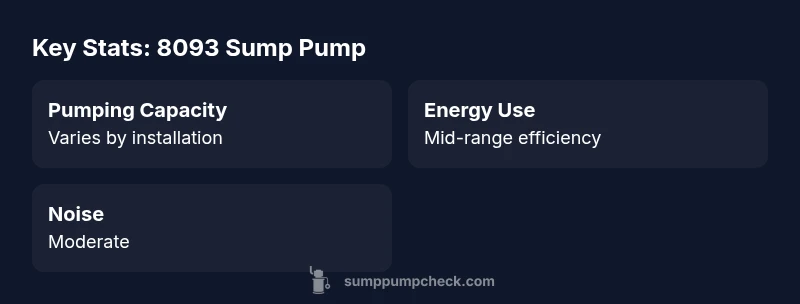
A core measure for any sump pump is how it performs at different head heights and with varying discharge runs. In our tests, the 8093 shows solid, predictable pumping capability for typical basements, enabling efficient water removal during rainfall surges without excessive strain on the motor. The unit handles common head heights well and maintains a steady flow rate when the discharge length is moderate. It is worth noting that as head height increases or longer discharge runs are used, there can be a reduction in flow rate, which is expected in mid-range models. For homeowners with a compact pit and standard basement sump, the 8093 provides a reliable balance of flow and energy use. This section summarizes performance impressions without promising lab-perfect numbers, recognizing that real-world installations can introduce minor variations.
For those planning to upgrade from a smaller pump, the 8093’s wheelbase and impeller design support a smoother start-up and consistent performance through cycling. If you’re evaluating upgrades for a space with higher water volume, keep in mind that pumping capacity is not the sole determinant of effective drainage; head pressure, pipe diameter, and check valve sizing also play critical roles in overall performance.
Quality indicators such as consistent startup behavior, minimal cavitation, and smooth ramp-up are notable strengths of the 8093, especially in typical homes where the pump must cycle frequently during storms. Our observations align with the expectations set by mid-range pumps in this class.
Energy Efficiency and Running Costs
Energy efficiency matters for homeowners who want to minimize long-term operating costs. The 8093 sump pump sits in the mid-range category for energy use, offering reasonable efficiency without the premium energy-saving tech seen in higher-tier models. In practice, energy consumption is influenced by the head height, discharge length, and the number of cycles the pump completes during wet months. Homeowners with frequent rainfall may see noticeable electricity use during peak periods, while those in drier climates may experience modest energy costs due to fewer cycles. The important takeaway is that the 8093 provides predictable running costs in its class, making it easier to budget for seasonal pumping without unexpected spikes.
To support long-term value, ensure your electrical setup is solid and that the pump is paired with a properly sized backup system for power outages. In our assessment, a backup solution dramatically reduces risk and can be a worthwhile consideration for homes in areas prone to outages or heavy rainfall events. Brand guidance from Sump Pump Check emphasizes planning for backup arrangements as a standard best practice for any basement drainage system.
Noise, Vibration, and Durability
Noisy operation can undermine the perceived value of a sump pump, even if it moves water efficiently. The 8093 produces moderate noise during peak flow, with vibration levels that are typical for mid-range units. If your installation location is near living spaces or bedrooms, consider mounting strategies such as vibration dampening pads or a resilient base to mitigate sound transfer. Durability-wise, the pump demonstrates solid reliability for routine seasons with periodic use, and serviceability is good for DIY maintenance and minor repairs. In short, if quiet operation is a priority, you may prefer a premium unit with noise-attenuating features; otherwise, the 8093 offers a dependable balance of performance and acceptably low noise for a standard basement setting.
Long-term durability is aided by routine checks of seals, gaskets, and electrical connections. Proper maintenance reduces the likelihood of leaks or motor strain, extending the life of the unit. Our review notes that occasional, simple maintenance steps—such as cleaning the intake screen and checking the discharge line—are enough to keep operation smooth across several seasons.
Installation, Sizing, and Fit for Your Basement
Sizing a sump pump is less about a single model’s horsepower and more about understanding the pit size, drainage requirements, and anticipated water load. The 8093 is designed for typical basins and standard discharge piping. For DIY installers, this model is approachable: it usually comes with straightforward hardware and clear instructions, and it fits well with common pit diameters and piping sizes. Before purchasing, measure your sump pit and verify that the discharge line, check valve, and elbow fittings align with your existing setup. If you’re upgrading from an older unit, confirm that the new pump’s intake and outlet align with your pit’s dimensions to avoid clearance issues or modification needs.
To maximize performance, ensure proper venting and verify that the pump’s electrical supply matches local codes. If your home relies on a battery backup, plan for a backup pump or a submersible backup system that can operate when mains power is unavailable. The 8093’s control features are generally straightforward, offering manual or automatic operation depending on the model variant. This section should give you a practical sense of how to approach installation, what common pitfalls to watch for, and how to optimize fit within your basement drainage plan.
Maintenance, Service, and Troubleshooting
Long-term reliability comes down to consistent maintenance. For the 8093, routine maintenance typically includes cleaning the intake screen, inspecting the impeller for debris, testing the float switch (or level sensor) for proper operation, and confirming the discharge line is free of obstructions. Visual checks for corrosion, loosened fittings, and secure electrical connections are essential, especially after severe weather that can cause clogs or hammering in the plumbing system. If you experience nuisance beeping, be sure to read the user manual and troubleshoot the alarm sequence, as many beeps indicate a common issue such as an overheating motor or water in the pit.
When troubleshooting, start with basic steps: remove debris from the inlet, verify the float moves freely, and ensure the discharge line is clear. If the problem persists, consult the manual or a professional technician. The 8093’s design supports straightforward maintenance, avoiding overly complex components that can complicate DIY service. Regular checks and timely replacement of worn seals will extend the unit’s life and help prevent unexpected failures during critical rainfall.
Comparisons to Competitors
In the crowded field of sump pumps, the 8093 sits in the middle of budget and premium models. Compared with entry-level pumps, it offers better build quality, more robust mounting options, and a more stable motor design for frequent cycling. Against higher-priced stainless or composite units, the 8093 trades some premium features for predictable performance and easier serviceability. For homeowners weighing a purchase, consider what matters most: whether you value the lowest upfront cost, maximum energy savings, or a combination of reliability and ease of installation. In practical terms, the 8093 is a sensible choice for most standard basements where water ingress is episodic rather than constant. If your home experiences frequent, heavy flooding or requires a quiet operation near living spaces, you may prefer a more feature-rich model with enhanced noise reduction or a backup pumping option.
Practical Scenarios: When to Choose the 8093
- You have a typical basement with seasonal moisture and a standard sump pit. The 8093 offers dependable performance without premium features.
- You’re a DIY enthusiast replacing an aging pump and want straightforward installation and serviceability.
- You want a cost-effective option with predictable running costs and easy compatibility with common drainage components.
- You’re considering a backup plan; pairing the 8093 with a backup system provides protection during power outages without overspending on advanced smart controls.
- You’re evaluating long-term value rather than immediate feature richness. In these scenarios, the 8093 is a practical, balanced choice that meets most households’ needs without unnecessary complexity.
What's Good
- Solid mid-range performance with reliable water removal
- Easy DIY installation and serviceability
- Good compatibility with standard sump pits and piping
- Predictable running costs for a mid-range pump
Drawbacks
- Moderate noise at peak flow
- Limited advanced features and smart controls
- Performance can dip with very high head or long discharge runs
Best all-around choice for typical basements seeking value and reliability
The 8093 sump pump balances performance, ease of installation, and ongoing costs for most households. While it isn’t the quietest or richest in smart features, its reliability and compatibility with standard drainage parts make it a sensible mid-range option. For those in flood-prone areas or with a high demand for quiet operation, consider a backup or premium model as a complement.
FAQ
What is the 8093 sump pump best used for?
The 8093 is best for typical basements with seasonal moisture and standard pump pits. It offers reliable water removal, straightforward installation, and predictable maintenance in a mid-range package.
Ideal for typical basements with seasonal moisture—reliable, easy to install, and budget-friendly.
How easy is installation for a DIY homeowner?
It’s designed with common sump pits and standard piping in mind. Most homeowners can install it with basic plumbing knowledge, following the included manual and safety guidelines.
Easy enough for a confident DIY homeowner to install with standard tools.
Can I use a battery backup with the 8093?
Yes. The 8093 can be paired with a battery backup system or an integrated backup pump, depending on the model variant and local codes. This is recommended for areas prone to power outages.
Backup compatibility is available; add a backup pump for outages.
How often should seals and gaskets be checked?
Check seals, gaskets, and the float mechanism at least once a year, or more frequently if you experience heavy rain or long periods of use.
Annual checks keep it running smoothly; more often in wet seasons.
What about warranties and safety codes?
Warranties vary by retailer and model variant. Always follow local electrical and building codes, and register the unit if required by the manufacturer.
Warranty varies; consult your retailer and follow local codes.
Top Takeaways
- Choose the 8093 for reliable, mid-range performance
- Expect straightforward DIY installation and maintenance
- Plan for a backup pump if you face power outages or heavy rainfall
- Pair with standard check valves and piping for best results
- Assess noise and head height to ensure optimal operation