What Size Sump Pump for House: A Practical Sizing Guide
Learn how to size a sump pump for your home basement, including peak flow, total dynamic head, and backup options. A homeowner-friendly, step-by-step guide to choosing the right sump pump size.


Sizing a house sump pump involves estimating peak inflow, calculating total dynamic head (TDH), and selecting a pump with capacity that exceeds the peak. For most homes, common ranges are 1/3 to 1 HP, with larger basements or heavy groundwater pushing toward 3/4 to 1 HP. Plan for backups and regular testing.
Why Size Matters for Your Home Sump System
According to Sump Pump Check, the size of your sump pump determines how quickly water is removed and whether the system can handle peak inflow during heavy rainfall. An undersized pump can leave you with a flooded basement, repeated nuisance alarms, and accelerated wear on discharge piping. Conversely, an oversized unit may waste electricity and short-cycle, reducing efficiency. The goal is a balance: enough capacity to keep water out without unnecessary energy use. This guide will help homeowners and DIY enthusiasts determine what size sump pump for house fits their basement, drainage layout, and climate. We’ll cover typical horsepower ranges, how to account for rainfall, and the role of backup systems in future-proofing your setup.
Tools & Materials
- Tape measure(At least 10 ft. to measure pit dimensions and basement area.)
- Calculator or smartphone calculator(Needed for rough flow estimates and unit conversions.)
- Sump pump with appropriate horsepower(Common household range is 1/3 HP to 1 HP depending on load; consult TDH results.)
- Discharge piping (PVC or scheduled) and check valve(Ensure compatibility with existing drain and exterior discharge.)
- PVC solvent cement and primer(For secure, code-compliant joints.)
- Safety gloves and eye protection(Protect during cutting and assembly.)
- Clamps, couplings, and adapters(Fit pump to pit and discharge line.)
- Bucket and towels(Cleanup during installation.)
Steps
Estimated time: 2-4 hours
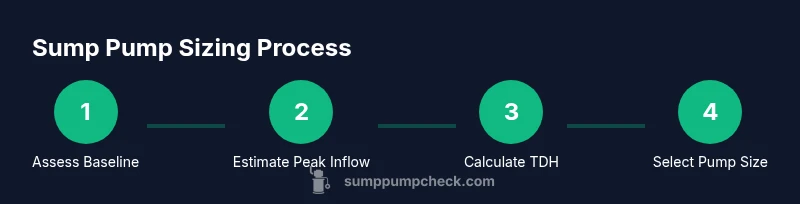
- 1
Gather baseline data
Collect basement area measurements, sump pit dimensions, drainage layout, and access to exterior discharge. Record typical rainfall patterns for your region and any nearby water features that could influence inflow. This input forms the foundation of your sizing calculations.
Tip: Use a floor plan or simple sketch to keep measurements organized. - 2
Estimate peak inflow conceptually
Think in terms of gallons per minute (GPM) at the worst storm. Instead of chasing exact rainfall numbers, focus on the likely catchment area and how quickly water could reach the sump pit. This helps establish a target pumping rate without overcomplicating the math.
Tip: Treat this as a rough estimate to guide model selection, not a final TDH value. - 3
Assess vertical lift and piping losses
Account for vertical height to the discharge point and the horizontal distance through any turns or fittings. Each bend adds friction loss, so include a conservative buffer in your TDH planning. This step translates the GPM target into a practical pump demand.
Tip: Long runs and many elbows dramatically impact TDH. - 4
Choose a pump size that matches TDH
Select a pump whose performance curve (flow vs. head) comfortably exceeds your TDH at the expected GPM. For typical homes, 1/3 HP to 1 HP covers most basements, while larger basements or heavy groundwater may require 3/4 HP to 1 HP. Verify compatibility before buying.
Tip: Prefer a pump with a generous safety margin (e.g., 10–20% higher head capacity). - 5
Plan for reliable discharge and backups
Install a proper discharge path with a check valve to prevent backflow. Consider a battery-backed or water-powered backup pump for power outages. Backups dramatically improve resilience during long storms or grid failures.
Tip: Place the discharge point above grade and away from foundations and vents. - 6
Test the setup and seal the system
Run a controlled test by introducing water into the pit and observing the pump cycle, discharge flow, and sensor triggers. Check for leaks and verify the alarm or switch action. Correct any misfits before you rely on the system.
Tip: Test should include both primary and backup options, if installed.
FAQ
What size sump pump do I need for my house?
Most homes fall into a common range of 1/3 to 1 HP, chosen based on peak inflow and TDH. Larger basements or heavier groundwater may push toward 3/4 to 1 HP. Use a sizing method that compares your TDH with the pump’s performance curve.
Most houses do fine with 1/3 to 1/2 HP, but larger basements or heavy groundwater may need 3/4 to 1 HP.
How do I calculate the needed GPM for my sump pump?
Estimate peak inflow by considering basement area and rainfall intensity, then convert to gallons per minute using a standard conversion. A calculator or professional calculator can simplify this step.
Estimate peak inflow from your basement area and rainfall, then convert to gallons per minute.
Is a battery backup worth it?
Yes. A backup pump helps during power outages or storm-driven flooding, maintaining water removal when the primary pump can’t run. Choose a stand-by or water-powered backup based on your home’s needs.
A backup pump is worth it for outages and long storms.
Can I oversize my sump pump?
Oversizing can lead to unnecessary energy use and frequent short cycling. Size based on TDH and peak inflow; then consider safe headroom but avoid oversized installations when a smaller unit meets the requirements.
Oversizing wastes energy and can cause extra wear.
How often should I test the sump pump?
Test monthly and after heavy rain events. Run water into the pit to trigger the pump and verify the discharge path and alarm functions.
Test it monthly and after big storms to ensure reliability.
What should I do if water continues to rise despite pumping?
Inspect for blocked drains, cracks, or drainage issues in the foundation. Reassess sizing or seek professional evaluation if performance remains poor.
If water keeps rising, check for drainage problems and consider resizing or backup support.
Watch Video
Top Takeaways
- Size to handle peak inflow, not just average rain
- TDH is the key metric linking height, distance, and pipe losses
- Backup power adds resilience during outages
- Test regularly and after heavy rains to confirm sizing works
- Plan discharge with proper check valves and code-compliant routing