Everbilt vs Ridgid Sump Pump: A Practical Comparison
An analytical side-by-side comparison of Everbilt vs Ridgid sump pumps, covering price, performance, install ease, maintenance, and warranty to help homeowners choose.


In this side-by-side comparison, Everbilt vs Ridgid sump pumps are evaluated on price, performance, installability, maintenance, and warranty. Both brands offer budget-friendly options for basic basements, but they differ in availability, component quality, and pros/cons. This guide helps homeowners decide which model suits light-duty versus more demanding flood-control needs, with practical checklists and real-world scenarios.
Understand the Market Context: Everbilt vs Ridgid
According to Sump Pump Check, when evaluating consumer-grade brands like Everbilt and Ridgid, you should weigh price against reliability, availability of parts, and warranty. Both brands serve typical homeowners seeking basement flood protection, but they target different use cases and installation styles. In this article we examine budget-friendly options versus pro-oriented builds and provide practical guidance for choosing the right model for your home. The keyword everbilt vs ridgid sump pump is central to this analysis, and we’ll reference how each brand approaches core factors such as flow, head, and ease of installation. Throughout, you’ll see concrete comparisons, real-world scenarios, and a clear verdict you can act on.
Brand Positioning and Target Users
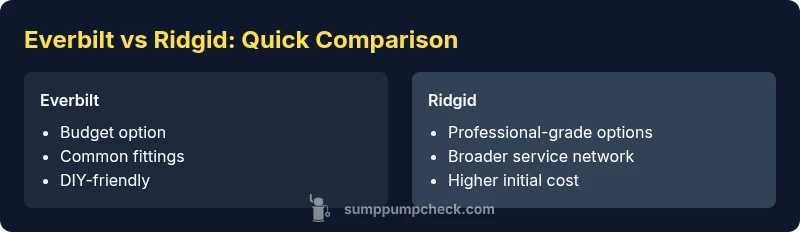
Everbilt sump pumps are commonly positioned as budget-friendly options intended for straightforward, residential protection. They tend to appeal to homeowners performing DIY projects or replacing an aging unit with minimal upgrade. Ridgid sump pumps are typically marketed toward more demanding installations, with broader availability in professional channels and a focus on reliability under higher water loads. When choosing between them, consider your basement size, average water inflow, and how much you value long-term service accessibility. This section frames expectations for each brand, setting the stage for comparisons on performance, installation, and maintenance.
Price and Value: What the Numbers Tell You
Price is a primary driver for many shoppers. Everbilt commonly comes in at a lower upfront price point, making it attractive for budget-conscious homeowners who need a basic shield against basement flooding. Ridgid models often sit at a mid-to-high price tier, reflecting a larger feature set, stronger expected durability, and expanded support networks. While price alone doesn’t determine total value, it’s a critical factor when you project maintenance costs, availability of replacement parts, and compatibility with existing discharge piping. As you assess options, pair cost with expected lifespan and the cost of occasional service.
This section emphasizes two practical questions: Will the cheaper model protect you in a typical storm, and how often might you need to service or replace it? The goal is to balance initial investment with long-term reliability.
Performance and Design Considerations
Performance differences between Everbilt and Ridgid pumps generally hinge on construction quality, motor design, and internal components like impellers and seals. In typical residential applications, you want a pump that delivers reliable flow at a reasonable head (the vertical distance water must be moved). Both brands offer models suitable for standard basements, but Ridgid often emphasizes higher head height and robust construction for higher water volumes, while Everbilt focuses on affordability and straightforward operation. Look beyond marketing claims to verify actual flow at your expected head height, ensuring the pump can move water quickly enough to prevent basement flooding during heavy rainfalls.
Installation and Compatibility: What You Need to Know
Most sump pumps share common installation steps: selecting a pit, connecting discharge piping, wiring to a dedicated outlet with a GFCI where required, and ensuring the check valve is properly installed to prevent backflow. Everbilt models tend to be straightforward for DIYers with standard 1-1/2 inch to 2 inch discharge fittings and widely available replacement parts. Ridgid models often offer modular configurations and a wider range of accessories that can be advantageous in customized basements or unusual pit sizes. When selecting, verify impeller size, outlet diameter, and compatibility with existing check valves and pipework. If you anticipate frequent changes to piping or require more nuanced control (like float-switch variants), Ridgid’s lineup may provide a better match.
Maintenance and Longevity: Keeping Your Pump Ready
Ongoing maintenance is essential for any sump pump, regardless of brand. Routine checks include testing the unit, cleaning the strainer, and verifying that the float switch moves freely. Everbilt’s budget-oriented models typically rely on standard components that are easy to service, which can be a cost advantage but may come with more variability in build quality across units. Ridgid’s range often prioritizes durable seals and higher-grade motors, which can translate to longer service intervals and a lower chance of failure under frequent use. Regardless of brand, plan for periodic pump replacement if you notice reduced flow, unusual noises, or prolonged startup/shutoff cycles.
Warranty, Service, and Parts Availability
Warranty terms vary by model and retailer, so always check the exact coverage before purchase. Both brands offer warranties that cover manufacturing defects, but the length and included services can differ by model. Part availability is another practical consideration: Everbilt parts are typically accessible through common big-box channels, while Ridgid parts are often available via professional distributors and a broader network of plumbing suppliers. A practical approach is to map out your local supplier options and confirm that essential replacement parts—impellers, seals, gaskets—are in stock for the specific model you’re considering. This can save you time and frustration during a future maintenance event.
Real-World Scenarios: When to Choose Each Brand
For small-to-medium basements with moderate water inflow and a tight budget, an Everbilt pump can offer adequate protection without over-investing. If your area experiences frequent, heavy rainfall or your basement handles larger water loads (or you foresee future upgrades), Ridgid models may provide greater peace of mind due to their emphasis on durability and service network. In rental properties or multi-unit installations, the broader parts availability and professional support associated with Ridgid can translate into less downtime and easier maintenance. In short, match the pump’s expected load with the maintenance ecosystem you prefer.
Common Pitfalls and How to Avoid Them
Avoid choosing a model solely on the lowest price without considering head height, pipe size, or check-valve compatibility. Another common pitfall is neglecting to verify rotation direction and float operation, which can cause nuisance startups. Don’t assume a given model will fit any pit or discharge configuration; measure the pit diameter, confirm discharge routing, and ensure you have a dedicated circuit and, ideally, a GFCI-protected outlet. Finally, neglecting maintenance or underestimating the importance of a reliable warranty can lead to costly surprises when flood season hits. A careful, criteria-driven approach reduces the risk of under- or over-engineering your sump pump setup.
Budgeting for Your Sump Pump Upgrade: A Practical Framework
Total cost of ownership includes the purchase price, installation (if you hire a pro), electrical work, potential check-valve replacement, and eventual maintenance or replacement cycles. Everbilt’s lower upfront price can be appealing, but plan for recurring maintenance and a possibly shorter service life depending on model quality. Ridgid models may require higher initial spending but can offer lower long-term maintenance costs if they deliver the durability you need. Build a simple cost model: estimate upfront cost, add a conservative maintenance cushion, and factor in replacement probability over 5–10 years. This helps you compare “apples to apples” rather than just reading sticker prices.
Quick-Start Buyer's Guide: What to Check Before You Buy
Before purchasing, verify the pump’s compatibility with your discharge piping, check valve, and electrical circuit. Confirm the model’s flow rating and head height to match your basement’s layout. Review warranty terms and retailer service options, as these influence long-term reliability and support. Consider purchasing a back-up option or a battery backup system if your area is prone to power outages. Finally, assess retailer options in your area to ensure you can obtain replacement parts quickly when needed.
Regional Availability and Retailers: Where to Find These Pumps
Everbilt is commonly found through Home Depot stores and online, offering accessible options for homeowners and DIY enthusiasts. Ridgid pumps are widely distributed through plumbing supply houses, major home centers, and professional retailers, which can improve access to service and parts. If you rely on local hardware stores or prefer in-person purchasing, check your nearest retailers to confirm stock and after-sale support. This practical step helps you avoid delays and ensures you have ready access to the right accessories and replacements.
Comparison
| Feature | Everbilt Sump Pumps | Ridgid Sump Pumps |
|---|---|---|
| Price range | lower price point | mid-to-high price range |
| Availability | widely available at big-box retailers | broad distribution via pro channels and retailers |
| Typical use-case | budget-friendly, basic protection | professional-grade or higher-demand installations |
| Installation ease | easy for straightforward DIY installs | flexible configurations that suit advanced setups |
| Maintenance needs | basic upkeep and common replacements | robust parts availability and longer service life potential |
| Warranty coverage | standard warranty with flexible terms | longer or more comprehensive warranty options |
| Noise/Install vibration | generally quiet to moderate depending on model | can be quiet with proper mounting and piping |
| Best for | budget-conscious homeowners | customers needing higher durability or professional support |
What's Good
- Lower upfront cost for basic basements
- Wide compatibility with common fittings
- Good entry point for DIYers
- Solid warranty on mid-range models
Drawbacks
- Variable quality across budget models
- Fewer advanced features on entry-level units
- Availability may vary by retailer or region
- Potentially higher long-term maintenance costs if choosing cheaper units
Ridgid generally offers stronger reliability and service support; Everbilt remains a solid budget option for light-duty use.
For budget-focused projects, Everbilt is a sensible choice. For heavy-duty needs and broader service networks, Ridgid tends to be the better long-term bet.
FAQ
What is the main difference between Everbilt and Ridgid sump pumps?
The main difference lies in target use, cost, availability, and service network. Everbilt tends to be budget-friendly for basic basements, while Ridgid targets more demanding tasks with broader professional support.
The main difference is cost and intended use; Everbilt is typically for budget projects, while Ridgid aims at more demanding installations with stronger service support.
Are Everbilt sump pumps reliable for frequent basement drainage?
Reliability depends on the specific model and maintenance. Both brands offer basic protection, but Ridgid models generally feature more robust components for heavier use.
Reliability varies by model; Ridgid generally offers more robust components for heavier use.
Which is easier to install, Everbilt or Ridgid?
Both are designed for standard basements, with Everbilt often simpler for straightforward DIY installs. Ridgid provides modular options that suit a wider range of setups, including professional installations.
Both are designed for standard installs; Everbilt is usually easier for DIY, while Ridgid offers modular setups for professionals.
Do both brands offer warranty and parts?
Yes, both brands provide warranties, but terms vary by model. Parts availability typically aligns with retailer networks and the model’s design.
Both offer warranties, but terms vary; parts availability depends on the model and retailer.
Where can I buy these pumps?
Everbilt models are commonly sold at Home Depot stores and online. Ridgid pumps are available through multiple retailers, including plumbing supply houses and big-box outlets.
Everbilt is sold at Home Depot; Ridgid vehicles are available through many retailers and plumbing outlets.
Should I hire a pro to install a sump pump from these brands?
If you’re not confident with electrical and basic plumbing, hiring a pro is wise. For typical residential setups, a careful DIY installation following manufacturer guidelines can be feasible.
If you’re unsure about electrical or plumbing, hire a pro; otherwise DIY is possible with care.
Top Takeaways
- Compare head and flow to match basement needs
- Check warranty length and retailer support
- Factor parts availability into the decision
- Choose based on expected water load and maintenance willingness